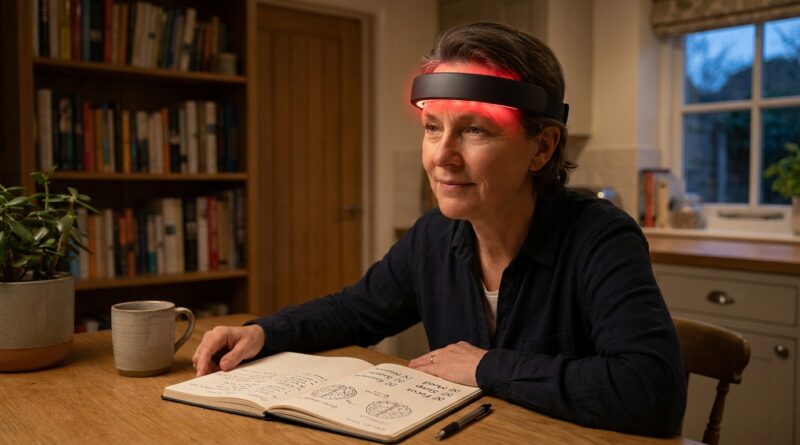
The Red-Light Brain Hack: How At-Home Near‑Infrared “Photobiomodulation” Is Quietly Moving From Fringe Gadget To Real Cognitive Tool
You can do a lot of things “right” and still feel like your brain is dragging. That is what makes this so frustrating. You sleep. You walk. You try the fish oil, the magnesium, the better morning routine. Yet names still slip away, focus fades by midafternoon, and the idea of buying a glowing “brain helmet” from the internet feels somewhere between hopeful and a little ridiculous.
Here is the good news. At-home transcranial photobiomodulation, which is the formal name for shining specific red and near-infrared light on the scalp, is no longer just a biohacker talking point. A newer home-based randomized controlled trial in people with mild cognitive impairment found that a specific setup improved global cognition and memory compared with sham treatment. That does not mean every red-light gadget works. Far from it. But it does mean this category finally has a real human signal worth paying attention to, especially if you want a non-drug, non-invasive option and you are willing to be picky about what counts as evidence.
⚡ In a Hurry? Key Takeaways
- Yes, at home transcranial photobiomodulation cognitive improvement is now backed by at least one meaningful home-based human trial, but only for a very specific type of device and protocol.
- If you are shopping, ignore vague “red light for the brain” claims and look for real specs: wavelength, power density, treatment schedule, and sham-controlled human data.
- This looks promising, not proven. It should be treated as a cautious experiment, not a replacement for medical care, sleep, exercise, hearing checks, or medication review.
What this “red-light brain hack” actually is
Photobiomodulation is a fancy name for using light at specific wavelengths to affect how cells work. For brain use, the devices usually rely on red or near-infrared light. Near-infrared is especially interesting because it penetrates tissue better than visible red light.
The basic idea is simple enough. Your brain cells need energy. Light in the right range may help mitochondria, which are the little energy factories inside cells, work a bit better. Researchers also think this light may help with blood flow, inflammation, and cell signaling. That is the theory.
The practical version is even simpler. You wear or place a device on the head for a set number of minutes, several times a week, over a period of weeks.
Simple does not mean magical. A light on your forehead is not automatically doing anything useful. The details matter a lot.
Why this has been so hard to take seriously
This field has had a branding problem for years. On one side, there are serious researchers studying light dose, wavelength, and clinical outcomes. On the other side, there are ads with glowing helmets, vague claims about “brain optimization,” and almost no useful technical information.
That leaves regular people in an annoying spot. If you ignore the whole category, you might miss a tool that could help. If you jump in too fast, you might spend hundreds or thousands on a gadget that is basically a fancy hat with LEDs.
The recent home-based trial matters because it moves the conversation out of pure theory and into something much more useful: did people at home, using a real protocol, get better results than people using a sham device?
What the newer home trial found
The headline version is this: in people with mild cognitive impairment, a home-use transcranial photobiomodulation protocol improved cognitive outcomes, including global cognition and memory measures, compared with sham treatment.
That is a big deal for three reasons.
1. It was home-based
That matters because a lot of promising therapies fall apart once they leave the lab or clinic. If a protocol only works with a technician hovering nearby, it is less useful in real life.
2. It was randomized and sham-controlled
This is the part that helps cut through hype. People often feel better just because they expect to feel better. A sham control helps researchers separate hope from actual treatment effect.
3. The participants had real cognitive issues
This was not just healthy people trying to get “laser sharp focus.” It was studied in people with mild cognitive impairment, which is the zone many families worry about because it can mean noticeable memory and thinking problems that go beyond normal aging.
That said, this is not the same as saying “all brain light therapy works” or “it prevents dementia.” It means one fairly specific approach showed encouraging results in one important human population.
Plain English reality check: promising does not mean settled
This is where a lot of coverage goes off the rails. Either the writer mocks the whole thing, or they act like we have discovered the fountain of youth with LEDs.
The truth is in the middle.
There is now a more credible reason to pay attention to at home transcranial photobiomodulation cognitive improvement. But the evidence base is still early. We still need more replication, larger studies, longer follow-up, and clearer answers about who benefits most, what dose works best, and how durable the gains are.
So the smart position is not “definitely buy one” or “definitely ignore it.” The smart position is “interesting enough to consider, but only with a strict filter.”
The buyer’s filter: how to spot a serious device versus a glowing toy
If you remember one section of this article, make it this one.
Look for the wavelength
Serious devices should tell you the wavelength in nanometers, often somewhere in the red or near-infrared range. Near-infrared often shows up around the 800s. If a product page just says “healing light” or “medical-grade red spectrum” without numbers, that is not good enough.
Look for power density or irradiance
You need to know how much light is actually reaching the area. This is often listed in mW/cm². Without it, you cannot even begin to judge dose. A company that refuses to share this is asking you to buy blind.
Look for treatment dose and schedule
How many minutes per session? How many sessions per week? For how many weeks? The trial result only matters if the consumer device follows something reasonably similar. Random “use daily as desired” instructions are a red flag.
Look for sham-controlled human data
Cell studies and mouse studies are a start, not the finish line. For a brain device, you want actual human data, ideally randomized and sham-controlled. Bonus points if the population studied looks like you or your family member.
Look for contact points and target areas
Some devices aim light at specific scalp regions. Others are broad helmets. More coverage is not always better if the power is weak or the protocol is sloppy. Ask where the light is meant to go and why.
Watch out for impossible claims
If a device claims to treat Alzheimer’s, anxiety, depression, concussion, insomnia, ADHD, hair loss, wrinkles, and fat burning all at once, take a breath. That is not a product page. That is a cry for skepticism.
Who might reasonably consider this now
This category makes the most sense for people who fit one of these groups:
- Adults with mild cognitive complaints who want a non-drug option to discuss with a clinician.
- People with mild cognitive impairment who understand the evidence is early but no longer purely speculative.
- Care partners who are willing to track outcomes carefully instead of relying on wishful thinking.
It makes less sense for people who want an instant productivity boost, hate routine, or are prone to buying expensive wellness gadgets without measuring whether they help.
Who should be extra cautious
Talk to a clinician before trying this if you have seizures, unusual sensitivity to light, active cancer in the treatment area, implanted medical devices near the head, a major psychiatric condition, or recent brain injury. Also talk first if the person has rapidly worsening confusion, new headaches, personality changes, or clear functional decline. Those are not “wellness experiment” issues. Those need proper medical evaluation.
And if memory problems are new, get the boring stuff checked too. Hearing loss, poor sleep, medication side effects, thyroid issues, B12 deficiency, depression, and uncontrolled blood sugar can all look like “my brain is slipping.”
A simple self-test protocol so you do not fool yourself
This part matters more than the gadget. If you try at home transcranial photobiomodulation cognitive improvement, you need a way to tell whether it is helping in real life.
Before you start, get a baseline for 2 weeks
Track a few simple measures:
- Word recall. Write down 10 unrelated words, review once, and test yourself 10 minutes later.
- Name recall. How often do you blank on names you should know?
- Mental stamina. Rate your focus at 10 a.m., 2 p.m., and 7 p.m. on a 1 to 10 scale.
- Everyday function. Did you miss appointments, repeat stories, lose track of tasks, or forget why you walked into a room?
- Partner feedback. If you live with someone, ask for one weekly rating of your memory and sharpness.
Keep everything else as steady as possible
Do not start the light device at the same time you begin creatine, stop alcohol, and switch to a new sleep schedule. If five things change at once, you will learn nothing.
Run the test for at least 8 to 12 weeks
Brain-related changes, if they happen, are not always obvious in a few days. Give it enough time to be fair.
Use a stop rule
If there is no noticeable change in your tracked measures after the test period, or if using the device becomes a burden, that is your answer. Not every promising therapy will be worth it for you.
What benefits should you realistically expect?
Think modest, not movie montage.
The most realistic hopes are things like a bit better memory test performance, less mental fading through the day, slightly easier word finding, or better consistency. You are not looking for a personality transplant. You are looking for whether the engine feels less sluggish.
If someone says a helmet made them “20 IQ points smarter by Tuesday,” keep your wallet in your pocket.
What side effects and downsides are worth knowing?
Transcranial photobiomodulation is generally described as non-invasive and low risk, especially compared with drugs or procedures. But low risk is not no risk.
Possible issues can include discomfort from the device, warmth, headaches, annoyance from the routine, eye safety concerns if the product is poorly designed, and plain old disappointment if the effect is too small to matter.
Then there is the money problem. These devices are often expensive, and many are sold with just enough science language to sound legit without giving you enough detail to judge them.
Why “specific protocol” is the key phrase here
The big trap in this space is assuming any red light equals the studied treatment. It does not.
A skin-care mask is not the same as a transcranial device designed to target the head. A gadget with the wrong wavelength, too little power, or a vague protocol may ride on the publicity of real studies without matching them in any meaningful way.
That is why you should keep coming back to one question: is this product meaningfully similar to what has actually been tested in humans?
At a Glance: Comparison
| Feature/Aspect | Details | Verdict |
|---|---|---|
| Evidence quality | A home-based randomized, sham-controlled human trial in mild cognitive impairment showed improvement in cognition and memory with a specific protocol. | Promising and worth watching, but not final proof. |
| Shopping value | Many products are vague about wavelength, power density, and dose. The best filter is transparent specs plus human trial data. | Be very selective. Most buyers should assume the market is noisy. |
| Best use case right now | Adults with mild cognitive issues or mild cognitive impairment who want a non-drug experiment and are willing to track results carefully. | Reasonable to explore with caution and realistic expectations. |
Should you try it now or wait?
If you are curious but cautious, that is actually the right mindset.
Try it now if you can answer yes to these questions:
- Can you afford the device without expecting a miracle?
- Can you confirm real specs and at least some human evidence?
- Can you use it consistently for weeks?
- Can you track whether it helps, instead of guessing?
Wait if you want stronger evidence, dislike routines, or cannot find a product that clearly explains what it is doing and why.
Conclusion
Red and near-infrared light for the brain has been stuck in a weird zone for a long time. Part biohacker folklore, part early-stage science, and very hard for normal people to judge. That is starting to change. Fresh data from a home-based randomized controlled trial in mild cognitive impairment suggests that a specific kind of at-home transcranial photobiomodulation can improve global cognition and memory compared with sham. For a non-drug, non-invasive tool, that is a real step forward.
The key is not to treat every glowing helmet as equally credible. They are not. Use a strict buyer’s filter. Ask for wavelengths, power density, protocol details, and sham-controlled human data. Then test it on yourself in a boring, disciplined way. That is how you cut through the marketing noise, lower the risk of wasting money, and make a smart call about whether this category is ready for you now, or better left for the next round of evidence.