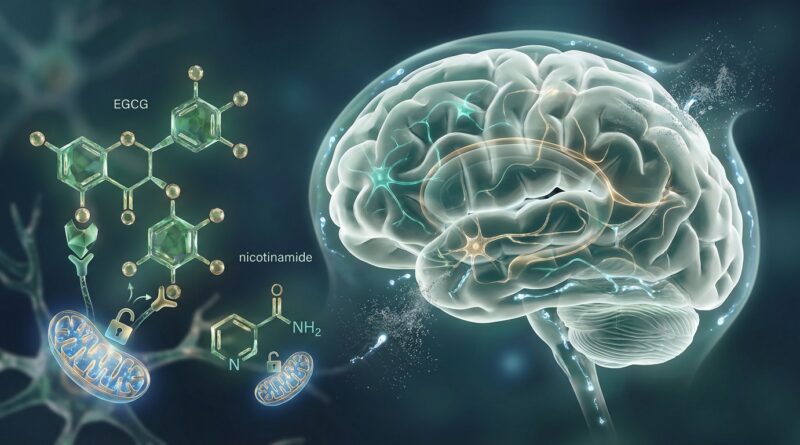
The EGCG + Nicotinamide Brain Combo: Why This Green Tea Stack Is The Quiet New Frontier In Cognitive Health
Trying to make a smart choice about brain supplements can feel weirdly exhausting. One post says green tea compounds clean up plaques. Another says NAD+ boosters are the missing link for brain energy. Then a third person swears the whole thing is nonsense. If you are looking at an EGCG nicotinamide nootropic stack and wondering what is real, you are asking the right question. The short version is this. There is genuine scientific interest here, but not enough proof to call it a miracle combo. EGCG, the best-known green tea catechin, has shown signs of helping with inflammation, oxidative stress, and protein handling in lab and early human research. Nicotinamide, a form of vitamin B3, matters because it feeds NAD+ pathways involved in cellular energy and repair. Put together, the idea is appealing. The evidence is promising, early, and worth watching. It is not yet a shortcut to a sharper brain.
⚡ In a Hurry? Key Takeaways
- EGCG plus nicotinamide is a promising brain-health idea, but human evidence is still early and nowhere near strong enough to treat it like proven prevention.
- If you are curious, start with the lowest-risk version first: green tea, exercise, sleep, blood pressure control, and a clinician check before adding concentrated supplements.
- Watch for red flags. High-dose green tea extracts can stress the liver, and high-dose B3 forms can cause side effects or interact with medical conditions and medicines.
Why people are suddenly talking about this combo
The interest is not really about “boosting your brain” in the old energy-drink sense. It is about protecting the brain quietly, years before obvious decline.
That is a different goal. Instead of chasing a quick hit of alertness, researchers are looking at a few slower, deeper systems. How well brain cells make energy. How they deal with inflammation. How they clear damaged proteins. How blood vessels support the parts of the brain most tied to memory.
That is where EGCG and nicotinamide start to make sense together.
EGCG in plain English
EGCG stands for epigallocatechin gallate. It is one of the main active compounds in green tea. Scientists have studied it for years because it seems to affect oxidative stress, inflammation, and the way cells respond to injury.
For brain health, the appeal is that EGCG may do more than one thing at once. In preclinical work, it has been linked to less damage from oxidative stress, possible effects on abnormal protein clumping, and support for cell survival pathways. More recent work has also drawn attention to the hippocampus, the memory-heavy part of the brain that often gets hit early in cognitive decline.
Nicotinamide in plain English
Nicotinamide is a form of vitamin B3. Your body uses B3-family compounds to make NAD+, a molecule involved in cellular energy production and repair. If that sounds abstract, think of NAD+ as part of the maintenance and power system that helps cells keep functioning under stress.
In aging research, NAD+ gets a lot of attention because levels and efficiency in related pathways may shift over time. That has led to interest in nicotinamide, nicotinamide riboside, and other B3-related compounds as possible support tools for the brain and blood vessels.
What makes the stack interesting, scientifically
The EGCG nicotinamide nootropic stack is interesting because the two compounds appear to target different pieces of the same larger problem.
EGCG is mostly discussed in terms of stress control, inflammatory signaling, and protein handling. Nicotinamide is mostly discussed in terms of energy metabolism, DNA repair support, and NAD+ biology. In theory, that means one could help with cell stress while the other helps with cellular fuel and recovery capacity.
That theory is exactly why people are excited. But theory is not proof.
Where the data looks promising
Here is the encouraging part. Recent 2025 to 2026 research has started to connect EGCG more directly to hippocampal protection in brains already considered at risk, rather than just in generic lab models. At the same time, newer human trials involving nicotinamide and nicotinamide riboside are trying to answer a more practical question: can B3-family compounds support cognition, vascular function, or both in real people?
That shift matters. It moves the conversation a little closer to everyday relevance. Not all the way there, but closer.
Where the data is still weak
There is still a huge gap between “biologically plausible” and “clinically proven.” Most supplement hype lives inside that gap.
We do not yet have strong, long-term human evidence showing that combining EGCG with nicotinamide prevents dementia, preserves memory in healthy adults, or reliably improves focus. We also do not have a settled answer on ideal dosing, ideal timing, or which people might actually benefit most.
So if someone online is talking about this stack like it is already solved science, they are getting ahead of the evidence.
What the real-world benefit might be, if it pans out
If this combo does prove useful over time, it probably will not look like a movie-style intelligence pill.
It would more likely be subtle. Slower decline. Better resilience under metabolic stress. Support for memory-related brain regions. Better vascular support. A little more “maintenance,” not a lot more “turbo mode.”
That may sound less exciting, but honestly, that is how the most serious brain-health work usually looks. Quiet. Boring. Important.
Who should be careful before trying it
This is the part a lot of supplement threads skip.
Be cautious with EGCG extracts if you have liver issues
Green tea in beverage form is one thing. Concentrated EGCG extract is another. High-dose extracts have been linked to liver safety concerns in some cases. That does not mean EGCG is bad. It means concentrated forms deserve respect.
If you have liver disease, drink heavily, use medicines that affect the liver, or have had odd reactions to supplements before, this is not a “just try it” situation.
Be cautious with nicotinamide if you have certain medical conditions
Nicotinamide is still a vitamin form, but dose matters. Higher intakes can bring side effects, and people with kidney disease, liver issues, diabetes concerns, or complicated medication lists should check with a clinician first.
Also, not every B3 form behaves the same. Nicotinamide is not identical to niacin, and nicotinamide riboside is another category again. A lot of online advice mashes them together when it should not.
Be especially cautious if you are pregnant, breastfeeding, or on multiple medicines
That is not fear-mongering. It is just common sense. Brain supplements often sound gentle because they are sold over the counter. That does not make them consequence-free.
Practical decision rules for normal people
If you want a plain-English framework, here it is.
1. If you want proven brain protection, start with the boring winners
Before buying a stack, make sure you have the basics covered. These have much stronger evidence than most supplements:
- Regular aerobic exercise
- Consistent sleep
- Blood pressure control
- Blood sugar management
- Hearing care
- Social activity
- Mediterranean-style eating pattern
- Green tea as a drink, if it agrees with you
That list is not flashy. It is also where most of the real risk reduction lives.
2. If you are healthy and curious, keep the experiment small
If you still want to explore this stack, do not start with extreme doses or a kitchen-sink supplement blend. Try one change at a time. Keep notes. Give it enough time to notice tolerance and side effects. And be honest about what you are feeling versus what you hope to feel.
3. If you have memory concerns already, do not self-diagnose with supplements
If you are having real forgetfulness, word-finding trouble, or changes other people notice, get evaluated. New memory symptoms deserve proper medical attention. A supplement stack should never be the first or only response.
4. If a product sounds too complete, trust it less
The more a product claims to improve memory, focus, plaques, mitochondria, mood, longevity, and “mental performance” all at once, the more careful you should be. That usually means marketing has outrun the data.
Low-risk ways to mimic the same mechanisms
This is the overlooked part. You can support some of the same broad pathways without buying a trendy stack.
For EGCG-like goals
If the goal is lower oxidative stress and healthier inflammatory signaling, the low-risk version includes green tea, colorful plant foods, exercise, and avoiding smoking.
For NAD+ and energy-pathway goals
If the goal is healthier cellular energy handling, the low-risk version includes sleep, exercise, healthy weight management, blood sugar control, and not drinking your way through the week.
For protein-clearance and brain housekeeping
This one sounds futuristic, but your body already has systems for it. Sleep is a big part of that story. So is exercise. So is keeping vascular risk factors under control.
That is why the smartest supplement conversation often circles back to lifestyle. Not because supplements are useless, but because the baseline machinery matters more than people want to hear.
So, is the EGCG nicotinamide nootropic stack worth trying?
For most people, the honest answer is “interesting, maybe, but not urgent.”
If you are healthy, realistic, and careful, it may be a reasonable area to watch or cautiously test with professional input. If you are hoping for clear short-term focus gains, you may be disappointed. If you are thinking in terms of long-range brain resilience, the idea makes more sense.
What you should not do is treat this as settled science. It is not. It is a live research topic with enough signal to deserve attention, but not enough certainty to deserve faith.
At a Glance: Comparison
| Feature/Aspect | Details | Verdict |
|---|---|---|
| Evidence quality | Mechanistically strong and increasingly interesting, but still limited by early-stage and mixed human data. | Promising, not proven |
| Expected benefit | More likely to support long-term neuroprotection pathways than deliver dramatic short-term focus effects. | Think maintenance, not magic |
| Safety and practicality | Green tea itself is low risk for many people, but concentrated EGCG extracts and higher-dose B3 products need more caution. | Reasonable only with dose awareness and common sense |
Conclusion
The reason this topic matters right now is simple. The future of focus is shifting away from one-off stimulant hacks and toward broader brain protection. That means supporting mitochondrial energy, NAD+ metabolism, and protein clearance before anything obvious shows up on a scan. Fresh 2025 to 2026 work is starting to link EGCG with hippocampal protection in at-risk brains, while newer trials with nicotinamide and nicotinamide riboside are testing how B3-family molecules may support cognition and vascular health. That is worth paying attention to. It is also worth keeping in perspective. The smart move is to stay curious without getting swept up. Use practical rules. Respect red flags. Start with the low-risk habits that hit many of the same pathways. Then, if you do experiment, do it carefully and with realistic expectations. That is how you stay ahead of the hype curve without falling for it.