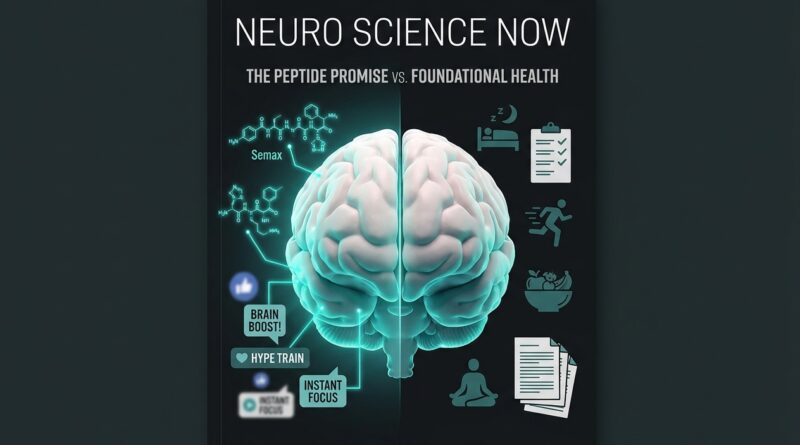
The Semax Hype Check: Is 2026’s ‘Limitless’ Peptide Really A Cognitive Breakthrough?
If you have been reading nootropics Reddit lately, your patience has probably been tested. One week it is a miracle mushroom. The next week it is a peptide with a cool backstory and a lot of confidence behind it. Semax is the latest example. Fans pitch it as a cleaner, smarter path to focus than stimulants, with fewer side effects and better mental clarity. That sounds great. It also runs ahead of the actual evidence. If you are trying to sort real cognitive benefit from clever peptide marketing, the short answer is simple. Semax is interesting, but the case for it as a proven nootropic in healthy adults is still weak in 2026. Most of the excitement comes from animal work, older regional literature, anecdotes, and vendor claims. If your goal is better attention, memory, and executive function, this is not one of those rare situations where the hype is clearly backed by strong human data.
⚡ In a Hurry? Key Takeaways
- Direct answer. Semax is not backed by strong, well controlled human evidence showing clear cognitive enhancement in healthy adults as of 2026.
- Actionable tip. If you are tempted to try it for focus, first fix the boring stuff that works better and costs less, especially sleep, training, protein intake, iron status, B vitamins, and caffeine timing.
- Safety and value note. Semax products sold online often live in a gray market, so purity, dosing, and long term safety are still question marks.
Why Semax suddenly feels like it is everywhere
That part is easy to explain. Semax checks all the boxes that internet health trends love.
It is a peptide. It has a medical sounding origin story. It gets described as “clean” and “advanced.” And because it is not the same old caffeine plus L-theanine stack, it feels fresh.
There is also a cultural pattern here. When people get tired of stimulants, they start looking for something that promises focus without the crash, less appetite suppression, and less anxiety. Semax slides neatly into that demand.
The problem is that “interesting mechanism” is not the same as “proven result.” A lot of compounds sound smart on paper and still fail the most important test. Do real people reliably think better on them under controlled conditions?
What Semax actually is
Semax is a synthetic peptide derived from a fragment related to adrenocorticotropic hormone, or ACTH. It has been discussed for years in Russian medical and nootropic circles, often with claims around neuroprotection, attention, learning, and recovery.
Mechanistically, people often point to effects on brain-derived neurotrophic factor, neurotransmitter systems, or stress signaling. Those are all plausible areas of interest. They are also where supplement and peptide marketing gets slippery.
A plausible mechanism is a starting point, not proof.
The key question: does Semax improve focus or memory in healthy adults?
Right now, the evidence says we do not know with confidence.
That answer annoys people because it is not exciting. But it is the honest one.
What the evidence seems to include
Most of the supportive discussion around Semax comes from a mix of preclinical studies, older publications that are hard for Western readers to verify in the usual evidence pipelines, and personal reports online.
Some of that work may suggest interesting neurological effects. Some may involve clinical contexts that are very different from a healthy person wanting better work focus. Those are not the same use case.
What the evidence still does not clearly include
As of 2026, there are still no widely recognized, registered, well controlled human trials showing clear cognitive enhancement in healthy adults. There are also no active Semax entries on major trial registries that would make a science minded reader feel much more confident that a clean answer is just around the corner.
That is the gap that matters most.
If somebody tells you Semax is “proven,” ask one boring question. Proven by what exact human trial, in what population, against what comparator, with what cognitive endpoints?
That question clears a lot of fog very fast.
Why anecdotes are not enough here
Anecdotes can be useful for generating ideas. They are lousy for settling debates.
Focus is especially hard to judge because it is subjective and easy to bias. If you buy an expensive peptide, read ten glowing reports, and expect a smooth productivity lift, your brain is already primed to notice every good hour and ignore every flat one.
There is also regression to the mean. Many people try nootropics during a bad stretch. If life naturally improves a bit the next week, the compound gets the credit.
And then there is stack confusion. The person saying “Semax changed my life” may also be sleeping more, using nicotine, cutting alcohol, fixing iron deficiency, or finally eating enough.
The “Russian peptide” problem
This is where otherwise careful readers can get tripped up.
A compound can have a long history of use in one region and still not have the kind of modern, transparent, easily checked evidence that clinicians and skeptical reviewers want. That does not automatically mean it does not work. It means confidence should stay limited until the data quality improves.
The internet often turns that uncertainty into mystique. People start treating the lack of clean evidence as proof that mainstream medicine is just behind the curve. Sometimes that is true. More often, it is just what weak evidence looks like before solid studies either confirm it or quietly bury it.
What about safety?
This part deserves more attention than it gets.
Even if Semax turns out to have some real effects, the average buyer is not getting a pharmacy grade product under tight regulation. They are often buying from research peptide vendors or gray market sellers where quality control can be inconsistent.
That raises three practical problems.
1. You may not be getting what the label says
Purity, contamination, storage conditions, and dose accuracy can all vary. With peptides, those details matter.
2. Long term use is still a foggy area
A compound can feel fine for a few days and still have unanswered questions around chronic use, tolerance, receptor effects, or downstream biology.
3. “No crash” does not mean “no cost”
Lots of compounds feel smoother than stimulants. That alone tells you almost nothing about whether they are effective, safe, or worth the money.
So is Semax a scam?
Not necessarily. That is too simple.
Semax is better described as an evidence-light candidate with a very enthusiastic online fan club. It may eventually earn a clearer place in cognitive or neurological care. But that is not the same as saying it is a current breakthrough for healthy adults who want better concentration at work.
Those are two very different claims. The first is possible. The second is still unproven.
What to do instead if you want better focus now
This is the part nobody wants to hear because it is less glamorous. It is also the part most likely to help.
Check the obvious bottlenecks first
If your sleep is inconsistent, your training is nonexistent, and your diet is running on snacks and coffee, a peptide is not your missing piece.
Start with:
- 7.5 to 9 hours of sleep opportunity most nights
- Regular resistance training and some cardio
- Enough protein and total calories
- Reasonable caffeine timing, not all day grazing
- Basic labs if fatigue or brain fog is persistent, especially iron status, B12, vitamin D, thyroid markers, and blood sugar issues
Use low drama interventions before high drama ones
If you want nootropic experimentation to be worth anything, make it disciplined. Change one variable at a time. Track sleep, mood, focus, and work output. Keep expectations modest.
That approach is less fun than peptide hype. It is also how you avoid fooling yourself.
How to spot weak Semax claims fast
Here are a few red flags.
- “Clinically proven” with no trial linked
- Heavy use of mechanism talk but no real world outcome data
- Claims that it replaces ADHD medication or all stimulants
- Testimonials used like evidence
- Vendors pretending a lack of mainstream adoption proves hidden brilliance
If the pitch leans more on mystery than methodology, slow down.
Who should be most skeptical?
Honestly, healthy adults who are already functioning fairly well.
If you are trying to squeeze out an extra 5 percent of productivity, you are exactly the kind of person likely to overspend on tiny, unclear effects. People in that group often have the least room for dramatic improvement and the highest risk of placebo-driven enthusiasm.
That does not mean do nothing. It means put your effort where returns are more predictable.
At a Glance: Comparison
| Feature/Aspect | Details | Verdict |
|---|---|---|
| Human evidence in healthy adults | No clear, widely recognized, well controlled trials showing reliable cognitive enhancement | Weak |
| Mechanistic appeal | Interesting biology and preclinical discussion around neurotrophic and neurochemical effects | Promising but not proof |
| Practical buying and safety issues | Gray market sourcing, uncertain purity, unclear long term data, hard to judge dose consistency | Real concern |
Conclusion
Semax may be the hottest peptide on forums right now, but hot is not the same as proven. Searches, Reddit threads, and peptide blogs have spiked because the story is appealing. A cleaner focus tool. A smarter alternative to stimulants. A hidden gem that mainstream medicine somehow missed. But when you strip away the vibe and look for solid human evidence, the picture is still murky. There are still no registered, well controlled human trials showing clear cognitive enhancement in healthy adults, and no active Semax entries on major trial registries to change that story in a big way. So the sensible move in 2026 is not blind excitement or smug dismissal. It is patience. Resist the peptide gold rush. Put your energy into sleep, training, stress control, and nutrient basics first. Then, if you still want to experiment, do it with your eyes open and your standards intact. That is how you stay curious without getting played.