The tACS Focus Protocol: How Gentle Brainwave Stimulation Is Quietly Beating Classic Nootropics For Working Memory
You know the feeling. The coffee kicks in, the nootropic stack seems promising, and for a little while you feel sharper. Then the hard part starts. A dense spreadsheet. A long strategy call. A task that needs you to hold three or four ideas in your head at once. Suddenly your focus slips, your mental scratchpad feels tiny, and all those capsules start to look a lot less impressive. That frustration is real, especially if you have already spent months cycling through caffeine blends, racetams, adaptogens, and “brain support” formulas that mostly help with energy, not actual working memory. What is starting to change the conversation is something much gentler and more targeted: theta tACS working memory cognitive enhancement. Put simply, this is low-intensity electrical stimulation designed to nudge the brain into rhythms linked with memory and attention, especially when paired with practice on the exact mental skill you want to improve.
⚡ In a Hurry? Key Takeaways
- Theta-band tACS is showing more specific gains for working memory than many supplement stacks, especially when used during cognitive training.
- If you are curious, think “brain stimulation plus practice,” not “brain stimulation instead of practice.” The pairing seems to matter most.
- This is promising but not a toy. Home use needs caution, and people with neurological or psychiatric conditions should only explore it with a clinician.
Why classic nootropics often hit a wall
Most supplements do one of three things. They increase arousal. They smooth stress a bit. Or they support long-term brain health in a general way. That can help. But working memory is not just about feeling awake.
Working memory is your brain’s temporary whiteboard. It is what lets you hold a phone number in mind, compare two ideas, follow a complicated conversation, or solve a problem with several moving parts. When that system is weak, you can still feel alert and yet perform badly on the tasks that matter most.
That is why so many people say, “I have more energy, but I am not actually thinking better.” They are not imagining it.
What tACS actually is, in plain English
tACS stands for transcranial alternating current stimulation. That sounds intimidating, but the basic idea is simple. Small electrodes are placed on the scalp. A very low electrical current is delivered in a repeating rhythm. The goal is not to force the brain to do something unnatural. It is to gently encourage brain networks to sync up at a frequency linked with a certain function.
For working memory, researchers are especially interested in theta rhythms, usually around 4 to 8 Hz. Theta activity has long been tied to attention control, memory updating, and the kind of mental juggling you need for complex work.
So when people talk about theta tACS working memory cognitive enhancement, they mean using a soft rhythmic current to support the brain timing patterns involved in holding and manipulating information.
Why the recent studies matter more than the hype
This field has had plenty of excitement before. The difference now is that randomized controlled trials are starting to show more than vague “brain boosting” claims.
Theta tACS plus training
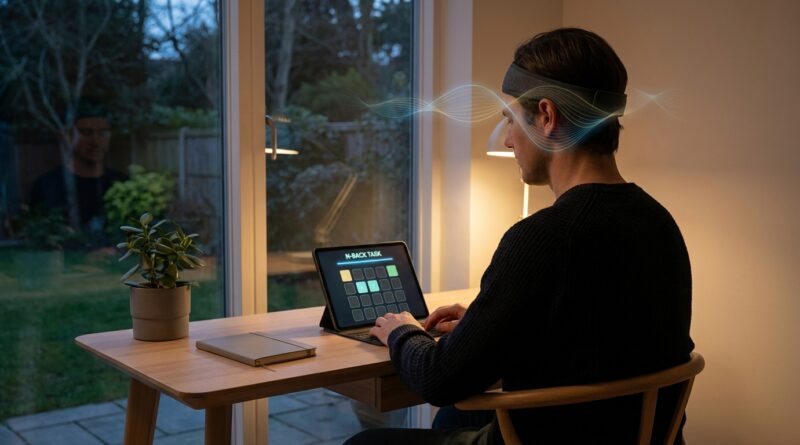
One of the most interesting findings from the recent wave of research is that theta-band tACS appears to work best when it is paired with a task like n-back training. N-back is not glamorous, but it is useful in research because it directly loads working memory. In newer studies, people did not just get stimulation and hope for the best. They trained while the stimulation was happening.
That matters. It suggests the current is not some magic switch. It may be helping the relevant brain circuits do their job while they are actively being used.
Specific gains, not fake “genius mode” gains
That is another important point. The better studies are not saying tACS turns people into superhumans. They are finding measurable improvements in targeted areas like working memory, executive control, and task performance. That is much more believable, and frankly more useful, than broad claims about becoming smarter overnight.
Results in vulnerable groups are especially interesting
Some of the strongest signals are showing up in groups where cognition is clearly under pressure. In mild Alzheimer’s, theta-band tACS during training improved performance and functional connectivity. In schizophrenia, prefrontal tDCS has shown selective working memory benefits without broad global side effects. Low-frequency pulsed stimulation has also been linked with EEG shifts that line up with better cognitive task scores.
Why should healthy professionals care? Because if a method can improve specific circuits under difficult conditions, that gives us a clearer map for how it might help healthy users who want better deep work, problem solving, or meeting stamina.
The big shift: from “take this” to “train this”
This is the real story. The old nootropic model says, “Swallow a thing and hope your brain feels better.” The newer stimulation model is more like physical therapy for attention and memory. You pair a gentle neural nudge with the exact mental motion you want to improve.
That is a much smarter framework.
If your weak point is working memory, the answer may not be another capsule with lion’s mane, citicoline, and caffeine. It may be a protocol that combines:
- the right brain rhythm, often theta for working memory
- the right target area, commonly prefrontal regions
- the right task, such as n-back or other demanding memory drills
- the right timing, with stimulation happening during practice
Researchers sometimes call this a kind of closed-loop idea, even when it is not fully automated. In plain English, you are matching the tool to the job in real time.
What this can look like in real life
For high performers
Let’s say you are a lawyer, founder, analyst, or student preparing for exams. Your issue is not motivation. It is mental drop-off during demanding cognitive work. A stimulation-plus-training approach could, in theory, fit into 20 to 30 minute deep work sessions where you actively practice the skill you care about.
Not generic “brain games.” Real cognitive stress that resembles your actual work.
For older adults or people with cognitive risk
This is where the research is especially meaningful. If someone is dealing with mild cognitive impairment or early decline, finding methods that help preserve working memory and executive control is a big deal. The fact that non-invasive brain stimulation is edging further into psychiatry and neurology tells you this is no longer fringe in the way it once was.
Still, for these groups, clinician supervision is not optional. It is important.
tACS vs tDCS. Quick, human explanation
People often mix these up, so here is the short version.
tACS
Alternating current. It oscillates. Think of it as trying to support a rhythm. This makes it especially interesting for brainwave-related goals like theta-linked working memory processes.
tDCS
Direct current. It flows one way. Think of it as changing how ready a brain area is to activate. It has been studied a lot for mood, rehabilitation, and some cognitive effects, including working memory in certain conditions.
Both are non-invasive. Both use low current. But if your search term is theta tACS working memory cognitive enhancement, the focus is on rhythmic entrainment rather than simple up-or-down excitability.
What the evidence does and does not say
What it does say
Recent randomized trials suggest that targeted stimulation can improve certain cognitive functions, especially when paired with practice. Working memory is one of the more promising areas. Effects may also line up with measurable brain changes, such as improved functional connectivity or EEG shifts.
What it does not say
It does not say everybody will benefit equally. It does not say more current is better. It does not say buying a consumer headset and zapping yourself during email will give you perfect concentration. And it definitely does not say supplements are useless. They may still help sleep, stress, or baseline energy. They just may not be the best tool for the very specific bottleneck of working memory.
If you are curious, here is the practical blueprint
Do not start by shopping for gadgets. Start by defining the problem.
Step 1: Name the weak point
Is it sustained attention? Working memory? Task switching? Mental fatigue after 45 minutes? Be specific.
Step 2: Match training to the weak point
If you care about working memory, use tasks that actually load working memory. Researchers often use n-back for a reason. You can also use structured memory updating drills, mental arithmetic, or domain-specific tasks that force active holding and manipulation of information.
Step 3: Treat stimulation as an add-on, not the hero
The pattern in the research is pretty clear. Pairing matters. Brain stimulation seems more useful when it supports active practice than when it is used alone like a passive enhancement trick.
Step 4: Respect safety and supervision
If you have seizures, implanted medical devices, a neurological condition, or a psychiatric diagnosis, this is a medical conversation, not a weekend experiment. Even healthy users should be careful about device quality, electrode placement, intensity, and session length.
Why this is quietly beating classic nootropics
Because it is aiming at mechanism, not mood.
A lot of nootropic products make you feel like something is happening. More alert. More driven. A little less foggy. That can be useful, but it is often broad and temporary. tACS, at least in the better studies, is being used to target the timing of specific neural networks involved in working memory and executive control.
That is a different category of intervention.
And unlike many supplement claims, these effects are increasingly being tracked with objective tests and brain measures, not just self-reports.
Important reality check before you buy into the trend
This is not ready for wild consumer hype. Results vary across studies. Protocols differ. Some findings are modest. And we still need better answers on who responds best, how long benefits last, and what the ideal frequencies and placements are for different people.
But “promising and specific” is still a big step up from “expensive and vague.”
At a Glance: Comparison
| Feature/Aspect | Details | Verdict |
|---|---|---|
| Classic nootropics | Often improve alertness, mood, or stress tolerance more than true working memory capacity. | Helpful for energy. Limited for the mental whiteboard problem. |
| Theta tACS with task practice | Targets brain rhythms tied to working memory, especially when used during training like n-back tasks. | Most promising option for specific cognitive enhancement, based on recent trials. |
| Safety and accessibility | Non-invasive and generally gentle, but still needs careful protocols, especially for clinical populations. | Promising, but best approached with expert guidance rather than DIY enthusiasm. |
Conclusion
Here is the encouraging part. Non-invasive brain stimulation has been edging into mainstream psychiatry and neurology for years, but the latest randomized trials are finally showing something that supplement-only stacks often struggle to deliver: measurable gains in specific cognitive domains like working memory and executive control, especially when stimulation is paired with task practice. In the most recent wave of studies, theta-band tACS during n-back training improved cognitive performance and functional connectivity in people with mild Alzheimer’s. Prefrontal tDCS selectively boosted working memory in schizophrenia without broad side effects. Low-frequency pulsed stimulation also shifted EEG patterns alongside better task scores. For regular people trying to think clearly through hard work, that points to a better blueprint. Stop chasing endless ingredients. Start thinking about closed-loop training, where your brain is gently nudged into the right rhythm while you practice the exact skill you want to improve, whether that is complex problem solving, studying, or deep work that lasts longer than one coffee buzz.