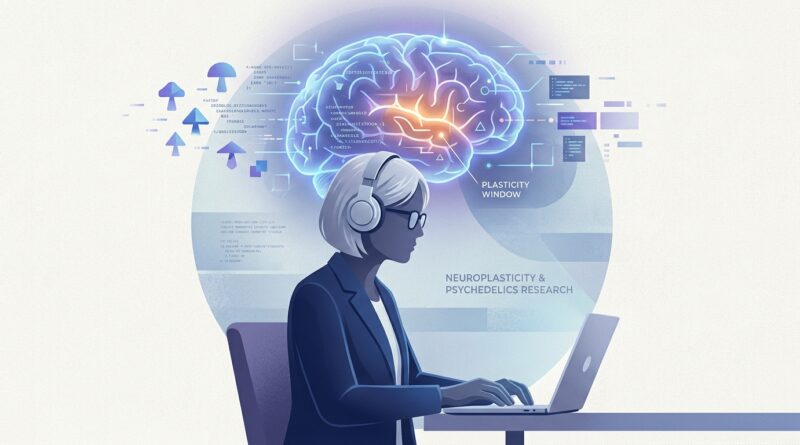
The Psilocybin Neuroplasticity Window: How ‘Micro-Dosed’ Therapy Is Quietly Moving From Fringe To Future Of Brain Health
You can be doing all the “right” things and still feel mentally flimsy. The supplements are stacked on the counter. The coffee is non-negotiable. Maybe there is a fancy nootropic subscription in the mix too. Yet your focus still slips, your memory feels less sharp than you want, and your long-term brain health plan is mostly crossed fingers. That is why so many smart, practical people have started side-eyeing psilocybin. Not because they want a wild trip, but because they keep hearing one phrase that sounds very different from the usual biohacking hype: neuroplasticity. The real story is not “magic mushrooms make you smarter.” It is much more specific. Researchers are asking whether carefully timed, carefully dosed psilocybin, paired with cognitive training or therapy, might create a temporary window where the brain is more ready to learn, adapt, and rebuild patterns. That is a lot more interesting, and a lot more useful, than another miracle stack.
⚡ In a Hurry? Key Takeaways
- Psilocybin is being studied less as a “productivity drug” and more as a possible way to open a short-term neuroplasticity window that may make therapy or cognitive training more effective.
- If you are curious, focus on the pairing, not the substance alone. Ask what training, therapy, or behavior change is meant to happen during or after that window.
- Be careful with gray-market microdosing claims. Evidence is still early, legality varies, quality control is weak, and self-experimenting is not the same as supervised clinical care.
The key shift is not psychedelics. It is timing.
For years, the psychedelic conversation was stuck in two extremes. One side treated psilocybin like a counterculture relic. The other treated it like a shortcut to enlightenment, creativity, and perfect mental health.
Neither view is especially helpful if you are a working adult who just wants better focus, better resilience, and a brain that still serves you well 20 years from now.
The more grounded view is this. Psilocybin may not be the main event. It may be the opener.
Researchers are increasingly interested in whether psilocybin can create a temporary period of heightened flexibility in the brain. During that period, old habits may loosen a bit, new learning may stick more easily, and targeted therapy or training may have a stronger effect.
That is what people mean when they talk about a “neuroplasticity window.”
What neuroplasticity actually means here
Neuroplasticity is just the brain’s ability to change. It can strengthen useful pathways, weaken unhelpful ones, and build new associations through experience.
That sounds abstract, but in real life it covers very familiar things. Learning a language. Recovering from stress. Changing an anxious response. Rebuilding attention habits. Adapting after injury. Even maintaining function as the brain ages.
Psilocybin seems to affect serotonin systems, especially the 5-HT2A receptor, which may help trigger changes linked to learning, emotional flexibility, and brain connectivity. Animal work and early human studies suggest it may increase markers related to synaptic growth and communication. That is promising. It is not proof of a miracle. But it is enough to make serious scientists pay attention.
Why “microdosed therapy” is getting attention
Most of the strongest clinical headlines around psilocybin involve full-dose, supervised sessions for conditions like depression, end-of-life distress, and addiction. But there is growing curiosity around smaller, repeated doses used alongside structured therapy or brain training.
This is where the phrase “microdosed therapy” starts to show up. The idea is simple. Instead of chasing a dramatic psychedelic experience, the goal is to gently nudge the brain into a more teachable state, then use that state on purpose.
That “on purpose” part matters a lot.
If future research supports this model, the winning formula may not be psilocybin alone. It may be psilocybin plus a protocol. Think attention retraining, memory work, guided psychotherapy, emotional regulation practice, or digital cognitive exercises.
Why this matters for focus
If your search term is basically “psilocybin cognitive training neuroplasticity focus,” you are already asking the right question.
The smart angle is not, “Will mushrooms make me laser-focused by Tuesday?”
The smart angle is, “Could a carefully managed intervention make attention training more effective, help me break mental loops that wreck focus, or support longer-term brain resilience?”
That is a very different kind of hope. It is less flashy. It is also more believable.
What the science actually suggests right now
Here is the honest version. The science is intriguing, but early.
There is decent reason to think psilocybin can affect neural flexibility, mood processing, and large-scale brain network activity. There is also growing interest in whether those effects could help with cognitive decline, aging, and early Alzheimer’s-related changes, especially when combined with structured intervention.
But if you are looking for settled, consumer-ready proof that microdosing boosts focus in healthy professionals, that is not where the evidence is yet.
What looks like signal
Signal includes a few things.
- Psilocybin has shown measurable effects on mood, perception, and brain connectivity in controlled settings.
- Researchers are actively studying how those effects may support therapeutic change and learning.
- There is serious interest in pairing psychedelic treatment with psychotherapy, habit change, and cognitive training rather than treating the substance as a stand-alone fix.
- Neuroplasticity and resilience are becoming central to the discussion, especially in aging and neurodegenerative risk.
What still looks like noise
Noise is everywhere too.
- Claims that microdosing reliably boosts creativity, focus, and productivity in everyone.
- Wellness brands selling vague “mushroom” protocols with little transparency.
- Social media anecdotes being treated like clinical evidence.
- People blurring together legal functional mushrooms and illegal psychedelic substances as if they are the same thing.
This is where readers need to stay sharp. Early science is not fake. But early science is also not the same as a polished treatment path you can safely order online.
The most useful model to watch: psilocybin plus training
If you remember one thing from this piece, make it this: the interesting future is combination care.
Think of psilocybin as potentially making the soil more workable for a short period. The actual planting still matters. If no seeds go in, nothing much grows. If bad seeds go in, you may reinforce the wrong patterns.
That is why researchers and clinicians are increasingly interested in pairing any neuroplasticity-opening intervention with something structured and intentional.
What that structure could look like
In the next five years, if this field matures well, the most credible programs may include:
- Pre-screening for mental health history and medical risk
- Clear dose control and product verification
- Guided preparation before treatment
- Cognitive exercises aimed at attention, memory, or executive function
- Therapy sessions to help lock in healthier emotional patterns
- Follow-up tracking for mood, sleep, focus, and function
That should sound more like rehab for the brain than a Silicon Valley performance hack. Good. That is exactly why it is worth taking seriously.
Who should be careful, or step back entirely
This is not a casual supplement story.
Psilocybin can have real psychological effects, even at lower doses. It may be a poor fit, or outright risky, for people with certain psychiatric histories, including psychosis-related conditions or bipolar spectrum concerns. It can also interact with medications, expectations, and environment in ways that are not trivial.
If a seller talks like this is as harmless as magnesium, walk away.
Big red flags in the current gray market
- No screening for personal or family mental health history
- No explanation of dose, source, or testing
- Claims focused only on productivity, hustle, or “limitless” performance
- No plan for therapy, integration, or follow-up
- Pressure to subscribe before you understand legality or safety
The more someone markets certainty, the less seriously you should take them.
What a high-functioning professional can actually do right now
You may not have legal access to any of this where you live. Even if you do, the best frameworks are still developing. So what can you do today that is practical and not reckless?
1. Stop treating focus as a stimulant shortage
If your focus plan is mostly caffeine plus guilt, that is already useful information. Attention is not just about alertness. It is also about stress load, sleep quality, habit loops, emotional friction, and whether your brain can shift in and out of deep work without constantly grabbing novelty.
That matters because future psilocybin-based options, if they become mainstream, will likely work best as part of a broader brain-health system, not as a rescue pill.
2. Start tracking what “better cognition” means for you
Be specific. Do you want fewer attention crashes? Better working memory? Faster recovery after stress? Less procrastination? More mental endurance in the afternoon?
If you cannot describe the problem clearly, you will be easy prey for hype.
3. Learn to ask better questions
If you ever evaluate a clinic, study, or future legal protocol, ask:
- What exactly is the treatment trying to improve?
- Is this about mood, attention, memory, aging, or trauma recovery?
- What training or therapy is paired with the dose?
- How is progress measured?
- Who should not do this?
- What happens after the session or treatment cycle?
4. Build the non-sexy basics now
This may sound boring next to psychedelics, but it is still the foundation. Sleep. Exercise. Blood sugar stability. Stress regulation. Social connection. Cognitive challenge. These are not old-news wellness clichés. They are the base layer of brain plasticity.
If a future psilocybin protocol does become available to you, these habits will likely improve your odds of getting something useful from it.
Why aging and early Alzheimer’s are part of this conversation
This is the part many people have missed. The field is not only chasing sharper meetings and cleaner inbox focus. Some of the most important questions are about resilience in aging brains.
Researchers are looking at whether plasticity-focused treatments might support learning, emotional adaptation, and function in people facing age-related cognitive decline or early Alzheimer’s-related changes. That does not mean psilocybin is a cure. It does mean the conversation has matured.
We are moving from “Do psychedelics expand consciousness?” to “Can carefully managed interventions help the brain stay adaptive for longer?”
That is a much bigger and more serious question.
At a Glance: Comparison
| Feature/Aspect | Details | Verdict |
|---|---|---|
| Psilocybin alone | May affect mood, perception, and brain flexibility, but does not automatically create lasting cognitive gains without structure. | Interesting, but incomplete |
| Psilocybin plus cognitive training | Matches the emerging “neuroplasticity window” idea, where therapy or training may be more effective during a period of greater brain adaptability. | Most promising model to watch |
| Gray-market microdosing | Weak quality control, mixed evidence, legal risk, and lots of marketing noise dressed up as science. | Use extreme caution |
Conclusion
The big value here is not that everyone should run out and try psilocybin. It is that the conversation has finally become more useful. Instead of vague talk about “consciousness hacks,” we are starting to see a more measurable, medically serious discussion about learning, memory, resilience, aging, and early Alzheimer’s risk. Most people still cannot tell signal from noise, and that is exactly why this matters for the Cognesium community right now. If you focus on the emerging model of carefully dosed psilocybin plus targeted cognitive training, you can prepare sensibly for what may come next. Ask better questions. Watch for red flags. Treat any future legal option as one piece of a bigger focus strategy, not another miracle molecule. That mindset will age much better than hype.