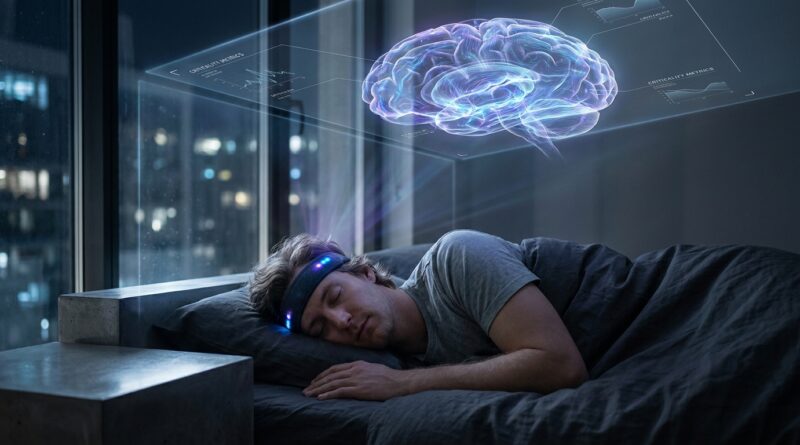
The Sleep Lab In Your Bedroom: How A New Wave Of EEG Headbands May Soon Predict Cognitive Decline Before It Starts
You can do a lot right and still feel like your brain is slipping at odd moments. The clean diet is there. The supplements are lined up. You train, you track, you try to sleep well. Yet some days your focus falls apart by 2 p.m., a word vanishes mid sentence, or your mental stamina just feels thinner than it used to. That is frustrating enough on its own. What really gets under the skin is the quiet fear behind it. What if this is not just stress or bad recovery. What if it is the start of something longer term.
A new study posted June 9, 2026 suggests your sleeping brain may show warning signs far earlier than standard memory tests do. More specifically, the fine structure of sleep EEG activity, the tiny electrical patterns your brain makes overnight, may work as a sleep EEG cognitive decline biomarker. That matters because it gives people a more concrete target than vague advice like “sleep more.” It also raises an obvious question. Can the new wave of EEG headbands bring some of this sleep lab insight into your bedroom, and if so, what should you actually do with the data?
⚡ In a Hurry? Key Takeaways
- A June 2026 study found that subtle overnight EEG patterns may predict future cognitive decline before normal memory tests pick it up.
- If you are an early adopter, start by tracking sleep consistency, next-day performance, and only then add a consumer EEG headband for trend watching, not diagnosis.
- Consumer devices are promising but not equal to a medical sleep lab, so use them as an early warning tool and talk to a clinician if your function is clearly changing.
Why this study is getting so much attention
Most brain health tracking today is indirect. We look at reaction time, resting heart rate, HRV, glucose swings, mood, and maybe some memory apps. Useful, yes. But these are downstream signs. They tell you how you performed. They do not always tell you what your brain was doing during the night when a lot of repair, sorting, and recalibration happens.
The new research points to something more specific. Instead of only asking how long people slept or how much deep sleep they got, it looked at the fine-grained electrical patterns of sleep itself. Think less “7 hours 42 minutes” and more “how flexible, coordinated, and healthy were the brain rhythms moving through the night?”
That shift matters. It suggests that the brain may become less adaptable before obvious symptoms show up on standard tests. In plain English, your nightly brain activity may start looking more rigid or less well organized years before anyone would call your memory impaired.
What “fine structure of sleep EEG” means in normal language
EEG stands for electroencephalography. It measures the tiny electrical signals produced by the brain. In a sleep lab, clinicians stick sensors on your scalp and watch how your brain moves through stages like light sleep, deep sleep, and REM.
But the new focus is not just on broad sleep stages. It is on the details inside them. That can include things like:
- How stable sleep spindles are
- How slow waves are shaped and timed
- How different brain rhythms line up with each other
- How variable or flexible these patterns remain across the night
You can think of it like listening to an orchestra. Old consumer sleep tracking mostly told you whether the orchestra played loudly, softly, fast, or slow. EEG analysis asks whether the players were actually in sync.
Why this could predict decline before memory tests fail
Memory tests are useful, but they are blunt tools early on. Many smart, high-functioning people can compensate for subtle changes for a long time. They can still do well enough in a clinic, especially on a good day.
Sleep is harder to fake.
When you are asleep, the brain is revealing its real operating style. If its rhythms are becoming less adaptable, less coordinated, or less efficient, that may show up there before it shows up in your day-to-day score on a simple recall task.
That is why this idea is such a big deal for people who already track health seriously. It opens the door to a biomarker that may be earlier, more objective, and potentially more sensitive than waiting for obvious lapses.
What a new EEG headband can and cannot do
What it can do
A good consumer EEG headband may be able to:
- Measure rough sleep stage patterns better than wrist wearables alone
- Capture at least some brainwave data overnight
- Show trends over weeks and months
- Help connect changes in sleep architecture with next-day brain performance
For an early adopter, that is already useful. Trend data beats guesswork. If your mental sharpness drops every time your overnight brain rhythms look fragmented, that is worth knowing.
What it cannot do
It cannot replace a full medical sleep study. At least not yet.
Consumer headbands have fewer sensors, simpler placement, more movement noise, and less expert review. They may miss problems a lab would catch. They also may overstate their precision in marketing copy.
So if you are asking, “Can this diagnose early Alzheimer’s or another neurodegenerative condition?” the honest answer is no. Not on its own. What it may do is help flag that your sleep-related brain dynamics are moving in the wrong direction, which is a different and still valuable thing.
The big idea: healthy brains stay adaptable
The key message from the study is not that one bad night means danger. It is that long-term patterns matter. Healthy brain systems tend to show a kind of flexible order. Not chaos. Not rigidity. They can shift states smoothly, recover, and coordinate rhythms across the night.
Cognitive decline may involve a drift away from that sweet spot. Less adaptability. Less healthy variation. More mechanical, less responsive patterns.
If that sounds abstract, think of it this way. A good athlete is not just strong. They are resilient. They adapt quickly. The same may be true for the sleeping brain.
What current wearables can approximate right now
If you do not own an EEG headband yet, regular wearables still help. They just measure from farther away. A wrist tracker or ring can estimate sleep duration, timing consistency, heart rate, temperature trends, and movement. Those are useful support signals.
But they are not direct brain signals. They infer sleep state from body clues. EEG actually listens to the brain.
That means the best current setup for many people may be layered:
- Use a ring or watch for baseline sleep timing and recovery trends.
- Use simple daytime tests like reaction time, working memory, and mood logging.
- Add a consumer EEG headband if you want a closer look at nightly brain dynamics.
This is where people often waste money. They buy the most advanced gadget first, without building a baseline. Do the boring part first. A month of steady sleep and daytime tracking makes any later EEG data far more useful.
A phased game plan for early adopters
Phase 1: Build a baseline
Track three things for 4 to 6 weeks:
- Bedtime and wake time consistency
- Subjective brain function, focus, word recall, afternoon stamina
- One simple daily cognitive measure, such as reaction time or a short memory task
This gives you context. Without context, every sleep chart turns into fortune telling.
Phase 2: Clean up obvious sleep disruptors
Before buying more hardware, fix the basics that directly distort sleep signals:
- Alcohol near bedtime
- Late heavy meals
- Wildly inconsistent sleep timing
- Overheating at night
- Excess caffeine too late in the day
- Untreated snoring or possible sleep apnea
This matters because a messy setup can make your data look worse than your underlying brain health really is.
Phase 3: Add EEG for trends, not panic
If you add a headband, look for repeatable patterns over weeks and months. Do not obsess over one night. You are trying to answer questions like:
- Are my sleep-stage patterns stable or getting more fragmented?
- Do changes in overnight brain activity match next-day mental performance?
- Am I becoming more sensitive to stress, travel, late meals, or overtraining?
That is where the value is. Not in a scary app score. In the pattern.
Phase 4: Escalate when the pattern and your real life match
If your data is trending poorly and you also notice persistent cognitive changes, get medical input. Especially if there is new forgetfulness, reduced work performance, unusual daytime sleepiness, changes in speech, or a partner reports loud snoring and gasping.
At that point, the wearable has done its job. It helped you stop guessing.
Who should pay the closest attention
This area is especially relevant if you:
- Have a family history of dementia or cognitive decline
- Notice worsening focus that does not improve with rest
- Have untreated sleep apnea risk
- Are over 40 and serious about long-term cognitive performance
- Already track HRV, glucose, training load, or productivity metrics
For these groups, sleep EEG may become one of the most useful missing pieces. Not because it predicts your fate with certainty, but because it gives you a more direct read on brain recovery than most home tools ever have.
What not to do
There are two easy mistakes here.
Do not treat every bad night as a warning sign
Stress, travel, illness, and late dinners can all distort sleep EEG patterns. The goal is long-term monitoring, not nightly drama.
Do not assume supplements can paper over poor brain dynamics
This may be the hardest pill for nootropic fans to swallow. If the sleeping brain is drifting toward less healthy rhythms, no stack can fully replace fixing the system underneath. You cannot out-capsule a damaged sleep architecture forever.
Why this changes the conversation for serious self-trackers
For years, “optimize sleep” mostly meant sleeping longer, or chasing a high deep-sleep score from a wearable that was making an educated guess. This research suggests we may finally have a more meaningful target.
Not just more sleep. Better brain dynamics during sleep.
That is a much sharper idea. It also fits with what many readers already suspect. Sometimes the problem is not motivation. It is not discipline. It is not even strictly total sleep time. Something about the night itself is off, and the day pays for it.
At a Glance: Comparison
| Feature/Aspect | Details | Verdict |
|---|---|---|
| Medical sleep lab EEG | Many sensors, expert interpretation, strongest data quality, can assess sleep disorders and richer brainwave detail | Best for diagnosis and deep evaluation |
| Consumer EEG headband | Direct brain-signal tracking at home, useful for trends, but fewer sensors and more noise than a clinic setup | Promising for long-term self-tracking, not a standalone diagnosis tool |
| Ring or watch sleep tracker | Measures body signals like movement, heart rate, and temperature, then estimates sleep state | Great for habits and consistency, limited for direct brain insight |
Conclusion
The most encouraging part of this story is that it gives people something more solid to watch than vague symptoms and wishful thinking. A brand new study posted June 9, 2026 shows that the fine structure of your sleep EEG signals can forecast who is on track for future cognitive decline long before memory tests fail. That is a real shift. It moves the conversation away from generic “sleep more” advice and toward a concrete, testable biomarker that serious nootropic users can follow alongside HRV, glucose, and reaction time. The smart move now is not panic buying every headband on the market. It is building a baseline, cleaning up the obvious sleep disruptors, and using EEG tools carefully to spot trends in your nightly brain dynamics. If this line of research holds up, the bedroom may soon become one of the best places to catch early warning signs while there is still time to respond.