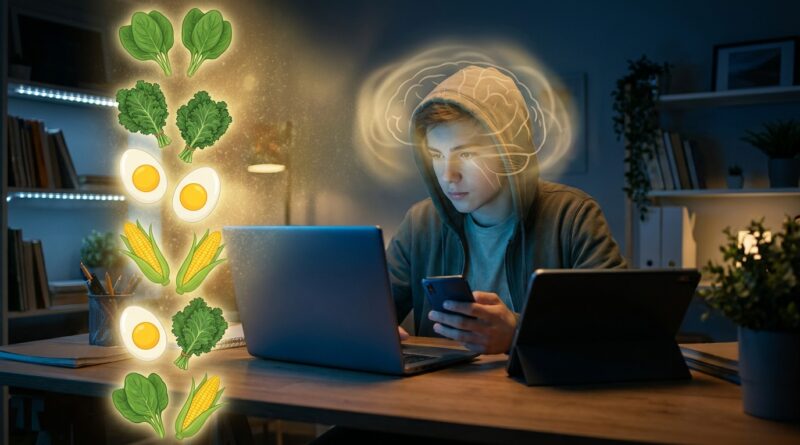
The Screen-Time Antidote: How Two Little-Known Carotenoids Just Sharpened Attention In Heavy-Device Teens
If you have a teenager who seems glued to a phone, then crashes when it is time to study, you are not imagining it. A lot of parents are seeing the same pattern. Sore eyes. Sloppy focus. Reading that somehow never turns into memory. The usual advice is either unrealistic or annoying. Lock up the phone. Buy expensive blue-light gadgets. Try a stack of brain pills with names nobody can pronounce. Here is the refreshing part. A controlled study suggests two simple nutrients, lutein and zeaxanthin, may help heavy-device teens do better on attention and processing tasks, while also supporting eye comfort. These are carotenoids found in foods like egg yolks, spinach, kale, corn, and orange peppers, and they are also sold in basic supplements. This is not magic, and it is not a free pass for eight-hour doomscrolling. But it is a practical, low-drama option that families can actually stick with.
⚡ In a Hurry? Key Takeaways
- Lutein and zeaxanthin may improve attention and visual processing in heavy screen-using teenagers, based on a controlled trial.
- Start with food first. Think egg yolks plus dark leafy greens most days, or a simple supplement that provides roughly 10 mg lutein and 2 mg zeaxanthin.
- These nutrients are generally low risk, but they work best as part of a bigger routine that also includes sleep, screen breaks, and decent lighting.
Why this matters to families right now
Teen life has moved onto glass. Homework is on a laptop. Friends are on Snapchat. Videos, games, group chats, school portals. It adds up fast.
The result is not just “too much screen time” in a vague moral sense. It is often a very specific set of complaints. Dry, tired eyes. Trouble staying on task. Mental fuzziness by late afternoon. Reading the same paragraph twice. Then poor sleep makes the next day worse.
That is why the topic of lutein zeaxanthin screen time cognitive performance teenagers is getting real attention. It sits right at the crossroads of eye health, brain performance, and daily life.
What are lutein and zeaxanthin, exactly?
Lutein and zeaxanthin are plant pigments called carotenoids. They are best known for collecting in the retina, especially in the macula, the part of the eye that helps with sharp central vision.
But they are not just “eye vitamins.” Researchers have also been interested in their role in the brain. These pigments appear in brain tissue too, and there is growing interest in how they may support processing speed, attention, and visual efficiency.
Why they are interesting for screen-heavy teens
Screens demand a lot from the visual system. You are staring at bright, high-contrast content, often at close range, for long stretches. That does not just tire the eyes. It can also drain attention.
Lutein and zeaxanthin are thought to help in two main ways:
- They help support the retina and may improve how the visual system handles light and contrast.
- They may also support brain function tied to attention, visual processing, and reaction speed.
That does not mean they “block all blue light” in some superhero way. It means they may help the body handle visual stress better.
What the study found
The trial that has people talking looked at heavy-device teenagers and tested whether adding modest amounts of lutein and zeaxanthin could improve objective measures of brain performance.
The headline finding is simple. Teens who took these carotenoids showed improvements in measures tied to attention and cognitive performance compared with controls. That matters because this was not just “I feel better” self-reporting. Researchers used actual performance tasks.
That is a big deal. Parents hear a lot of claims about focus supplements. Most are based on hype, tiny studies, or broad promises. This line of research is more grounded. It asks a practical question. Can basic nutrients, in realistic amounts, help kids who spend a big chunk of their day staring at screens?
What improved
While the exact test battery can vary by study, the reported benefits in this area usually involve things like:
- Better sustained attention
- Faster visual processing
- Improved accuracy on cognitive tasks
- Potential support for visual comfort and less strain
That does not mean every teen turns into a straight-A machine. It means there may be a measurable edge in the tasks that matter for school and screen-heavy learning.
Why a nutrient could help both eyes and attention
This is the part that makes the story more than a wellness fad.
When vision is under strain, the brain has to work harder just to keep up. If your eyes are uncomfortable, dry, squinty, or constantly refocusing, attention gets spent on basic visual survival instead of reading, memory, and concentration.
So if lutein and zeaxanthin help the visual system work more smoothly, that can have a knock-on effect. Less visual friction. Better task performance. A little more mental stamina.
That is why this topic is so useful. It bridges the old split between “eye supplements” and “brain supplements.” For screen-heavy teens, those two systems are linked.
How much lutein and zeaxanthin are we talking about?
Here is the good news. We are not talking about megadoses or a complicated nootropic plan.
A common evidence-based target is:
- Lutein: around 10 mg per day
- Zeaxanthin: around 2 mg per day
Those amounts are commonly used in eye health supplements and are realistic with a mix of food plus, if needed, a basic supplement.
Food sources that actually help
If you want to start with food, focus on these:
- Egg yolks
- Spinach
- Kale
- Collard greens
- Corn
- Peas
- Orange and yellow peppers
- Zucchini
Egg yolks deserve a special mention. They do not contain the highest raw amount, but the carotenoids they do contain may be easier for the body to absorb because they come packaged with fat.
A simple “screen shield” meal idea
Try this as a low-effort start:
- Two eggs at breakfast
- A spinach side, smoothie, or omelet add-in
- One serving of orange peppers, corn, or peas later in the day
- A dinner salad with dark greens and olive oil
That is not a perfect formula. It is just an easy way to stop relying on luck.
Should parents use a supplement?
Sometimes yes. Especially if your teen eats like many teens do, which is to say, not a lot of kale.
A basic lutein and zeaxanthin supplement can make sense if:
- Your child avoids vegetables most days
- Screen use is heavy and school demands are high
- Eye strain complaints are frequent
- You want a routine that is easier than policing every meal
Look for a straightforward product with around 10 mg lutein and 2 mg zeaxanthin. Take it with a meal that contains some fat for better absorption.
Safety notes
For most healthy teens, these carotenoids are considered low risk at standard doses. They are widely used in eye-health products.
Still, common-sense rules apply:
- Talk to your pediatrician if your teen has a medical condition or takes regular medication.
- Do not assume “more is better.” Stick with ordinary studied amounts.
- Supplements should fill gaps, not replace meals, sleep, or outdoor time.
What this will not fix
This is important. Lutein and zeaxanthin are not a cheat code.
They will not undo:
- Sleeping five hours a night
- Using a phone in bed until 1 a.m.
- Doing homework with six apps open
- Never taking visual breaks
If your teen is struggling, use these nutrients as one part of a sane plan. Not the whole plan.
The practical routine that makes the study useful
Here is the part parents usually want. Fine, but what do we actually do on Monday?
1. Build a food baseline
Aim for lutein- and zeaxanthin-rich foods at least five days a week. Eggs plus greens is the easiest pattern.
2. Add a basic supplement if food is unreliable
If meals are chaotic or vegetables are a battle, use a plain lutein and zeaxanthin supplement in standard amounts.
3. Use the 20-20-20 rule
Every 20 minutes, look at something about 20 feet away for 20 seconds. It sounds tiny because it is. Tiny works better than grand plans nobody follows.
4. Fix the lighting
Do homework in a well-lit room. High screen brightness in a dark bedroom is a recipe for visual fatigue.
5. Create a screen cutoff before bed
Even 30 to 60 minutes helps. The goal is not perfection. It is reducing the late-night visual and mental load.
6. Watch for results that matter
Do not obsess over abstract “brain optimization.” Look for real life signs:
- Less eye rubbing
- Fewer complaints of tired eyes
- Better homework stamina
- Less rereading
- More stable focus in the evening
What parents should say to a skeptical teen
Keep it simple. Do not pitch this like a lecture.
Try: “Your eyes and brain are both doing a lot of work on screens. There are a couple of nutrients that may help with strain and focus. Let’s try the low-effort version for a month.”
That goes over much better than “I read a wellness article and now you need a protocol.”
Why this approach stands out from the usual screen-time advice
A lot of screen-time advice fails because it asks families to become monks. No phones at dinner. No screens after 7 p.m. Weekend detoxes. Those ideas are sometimes useful, but they often collapse under real life.
This is different. It is additive, not punitive. You are not only taking something away. You are giving the body support it can actually use.
That is especially helpful for teens, because compliance matters more than theory. A routine that is 70 percent ideal and lasts a year beats a perfect plan that dies by Thursday.
At a Glance: Comparison
| Feature/Aspect | Details | Verdict |
|---|---|---|
| Evidence strength | Controlled trial data suggests lutein and zeaxanthin can improve objective attention and processing measures in heavy-device teens. | Promising and practical, though not the final word. |
| Ease of use | Can be added through eggs, leafy greens, and a simple supplement around 10 mg lutein plus 2 mg zeaxanthin. | Much easier than complex nootropic stacks. |
| Best real-world role | Supports eye comfort and cognitive resilience when paired with sleep, screen breaks, and better evening habits. | Useful as part of a routine, not a stand-alone fix. |
Conclusion
What makes this so valuable is how normal it is. No wild claims. No expensive gear. No “brain hack” theatrics. Just a tightly controlled study pointing to a realistic way to support screen-soaked teenagers whose focus and sleep are starting to slip. Lutein and zeaxanthin give us a rare bridge between eye health, blue-light stress, and cognitive performance, all in one plan parents can actually carry out. For the Cognesium community, that is the sweet spot. Practical, evidence-based, and sustainable. If your family is tired of vague digital wellness sermons and stimulant hype, start here. Put more of these carotenoids on the plate, consider a simple supplement if needed, and pair it with better screen habits. Small moves, repeated for months, are what usually change a teen’s real life.