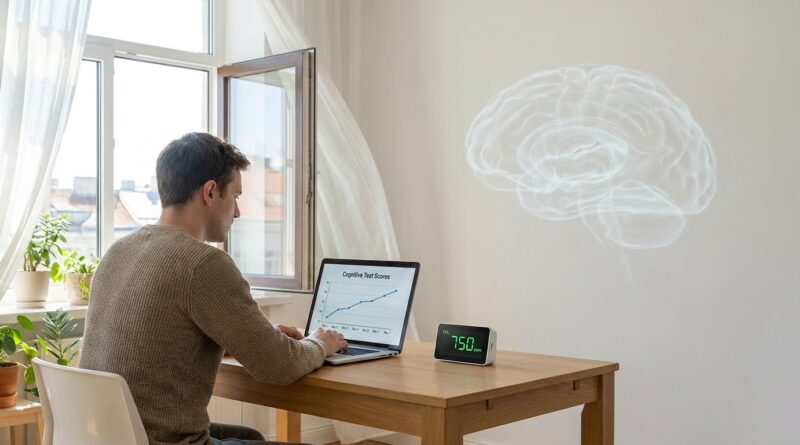
The CO₂ Brain Drain: How Cleaning Up Indoor Air Quietly Matched A Nootropic Stack In New Cognitive Data
You know the feeling. Lunch is over, your tabs are open, your to-do list is staring back at you, and your brain suddenly turns into wet cardboard. So you start troubleshooting yourself. Maybe you need better sleep. Maybe your stack is off. Maybe your caffeine timing is wrong. Maybe this is just what getting older feels like. That frustration is real, especially if you are already doing “everything right” and still crashing every afternoon. But sometimes the problem is not inside your body at all. It is in the room around you. Newer cognitive research has made one thing hard to ignore: indoor CO2 and cognitive performance are tightly linked, and many offices, bedrooms, and home workspaces drift into levels that can quietly slow thinking, hurt working memory, and blunt decision-making, even when the air does not feel stale. You can feel fine and still be underperforming.
⚡ In a Hurry? Key Takeaways
- Indoor CO2 can meaningfully hurt focus, working memory, and decision speed long before most people notice the room feels bad.
- Buy or borrow a CO2 meter, log your workspace levels for three days, then compare your brain performance before and after opening windows or improving ventilation.
- This is a low-risk, high-upside fix. For many people, cleaning up the air may do more for afternoon focus than adding another supplement.
The invisible productivity tax in your room
Most people think of indoor air as a comfort issue. Too hot, too cold, too stuffy. End of story.
But CO2 is different. It builds up when people breathe in enclosed spaces, especially rooms with closed windows, weak HVAC, long meetings, or overnight sleeping with the door shut. It is not a toxin in the dramatic, movie-scene sense at normal indoor levels. The problem is subtler. As CO2 rises, cognition can slip.
That matters if your work depends on writing, coding, planning, studying, trading, designing, managing people, or making good calls under pressure. In other words, if you use your brain for a living, this is not a side issue.
What the research is actually saying
The headline finding is simple: higher indoor CO2 is associated with worse cognitive performance, especially on tasks involving decision-making, strategy, response speed, and working memory.
One of the studies that got a lot of attention found substantial drops in higher-order decision performance as indoor CO2 moved up through levels commonly seen in offices. Later work has been more mixed on the exact size of the effect, which is normal in science, but the broad pattern keeps showing up. Indoor CO2 and cognitive performance appear linked often enough that it makes sense to test your own space instead of assuming your room is “probably fine.”
The key point is not whether every study lands on the exact same percentage drop. The key point is that the downside can be big, and the fix is usually cheap and safe.
The number that should get your attention
Once indoor CO2 starts climbing above roughly 1,000 ppm, many people are already in the zone where alertness and mental sharpness can suffer. Push toward 1,400 ppm and above, and the hit can get a lot more obvious in some datasets.
That sounds extreme until you realize how easy it is to hit those numbers in a small office, bedroom, conference room, or home setup with the door closed for hours.
Why this matters more than another capsule
A lot of nootropics conversations are built around tiny edges. Two percent here. Five percent there. A little smoother focus. Slightly better recall. Maybe.
Meanwhile, people are sitting in a room that may be cutting performance far more than any stack can add back.
That is why this story hits so hard. It flips the usual script. Before you spend more money trying to optimize brain chemistry, make sure your brain has enough fresh air to work with. It is not flashy. It is not branded. But it may be one of the most powerful “brain upgrades” available.
Why you do not notice it happening
This is the sneaky part. High indoor CO2 often does not announce itself clearly.
You may not feel short of breath. You may not feel dizzy. The room may even feel comfortable. What you do feel is vague. Sleepiness. A dip in motivation. More rereading. Slower word retrieval. More tab switching. That strange sense that your thoughts are moving through syrup.
So naturally, you blame discipline, stress, or yourself.
That is why measuring matters. Your senses are not a reliable CO2 detector.
What levels are common in real life?
Outdoor air is usually around 420 ppm, give or take. Indoors, things rise fast.
- Well-ventilated room: often under 800 ppm
- Typical lived-in indoor space: 800 to 1,200 ppm
- Closed bedroom or office with one person for hours: 1,200 to 2,000+ ppm
- Packed meeting room: sometimes much higher
If you work from home in a small room with the door shut, or sleep in a closed bedroom and then start working there in the morning, your “brain fog” room may be much worse than you think.
The easiest way to test your own space this week
You do not need a lab. You need a decent CO2 monitor and a simple before-and-after test.
Step 1: Get a CO2 meter
Look for a monitor that measures CO2 directly, ideally using an NDIR sensor. Avoid mystery gadgets that only estimate CO2 from other air signals. Those can be misleading.
If you do not want to buy one yet, borrow one. Some libraries, schools, and local groups lend air-quality tools.
Step 2: Log your normal day
For three days, change nothing.
- Put the monitor at desk height, not right next to your face
- Track morning, lunch, and mid-afternoon readings
- Take screenshots or photos of the readings
- Note when you feel sharp versus foggy
You are looking for patterns. Does the 2 PM slump line up with CO2 climbing past 1,000 or 1,400 ppm? Often it does.
Step 3: Pair it with a simple brain test
This is where the experiment gets fun.
Run one short cognitive test at the same times each day. Keep it simple. Use a reaction-time test, n-back task, typing speed test, or a timed round of mental math. The exact tool matters less than consistency.
Do it under your normal room conditions first. Then do it again after improving the air.
Step 4: Improve the air, then rerun the test
For the next three days, try one or more of these:
- Open a window
- Open the door
- Run HVAC fan continuously if your system allows it
- Add a window fan or exhaust fan
- Move to a larger room
- Take 5-minute air breaks every hour
Then compare your scores and your CO2 readings side by side.
This is the part most people never do. They guess. Do not guess. Measure.
A simple experiment-ready protocol
Days 1 to 3: Baseline
- Work as usual
- Record CO2 at 9 AM, 1 PM, and 3 PM
- Run the same 3 to 5 minute brain test at 10 AM and 2 PM
- Rate focus from 1 to 10
Days 4 to 6: Air cleanup
- Keep all meals, caffeine, and supplements as similar as possible
- Use your ventilation changes consistently
- Repeat the same readings and tests
What to compare
- Average CO2 at your desk
- Afternoon reaction time or working memory score
- Subjective focus rating
- How often you feel the urge to stop or procrastinate
If your CO2 drops and your performance improves, that is useful data. If nothing changes, that is useful too. Either way, you have moved from “maybe” to evidence.
What actually helps lower indoor CO2
This is not the same as filtering dust or smoke. HEPA purifiers are great for particles, but they do not remove CO2. That catches a lot of people off guard.
What works
- Fresh outdoor air through windows or doors
- Mechanical ventilation
- HVAC systems bringing in outdoor air
- Reducing the number of people in a small room
- Taking breaks outside
What does not solve CO2 by itself
- Standard air purifiers
- Nice-smelling sprays
- Lowering temperature alone
- Trying harder
Plants are lovely, but do not count on a few houseplants to rescue a small sealed office by 3 PM.
Bedrooms may be the hidden problem
Here is one more twist. Many people wake up foggy not because of “sleep inertia” alone, but because they slept eight hours in a closed room with rising CO2.
If your bedroom door stays closed and the windows stay shut, morning levels can get surprisingly high. Then you wake up and start your day in the same room. Your brain never really gets a clean start.
If this sounds familiar, test your bedroom overnight and right after waking. You may find your “bad mornings” have a very boring explanation.
How to think about this in the nootropics world
Supplements are not the enemy here. Plenty of readers like them, and some people find real value in them.
But environment comes first. The cleanest way to frame this is simple: do not stack compounds on top of a bad room and expect magic.
Fix the big rocks first.
- Air
- Sleep
- Light
- Movement
- Nutrition
- Then supplements
If indoor CO2 and cognitive performance are dragging you down all afternoon, even the best stack is working uphill.
Common mistakes people make
“The room feels okay, so it must be okay.”
Not reliable. CO2 can be high without obvious discomfort.
“I have an air purifier, so I’m covered.”
Great for particles. Not a fix for CO2.
“I only need to worry at extreme levels.”
No. The practical issue is that modest indoor elevations may still affect cognition.
“This is only an office problem.”
Nope. Bedrooms, dorm rooms, classrooms, gaming setups, and home offices are often the main culprits.
Who should care the most?
Almost everyone benefits from better air, but a few groups should pay special attention:
- Remote workers in small home offices
- Students studying in bedrooms
- Programmers and writers doing deep work for hours
- Anyone in long meetings
- People who feel sharp outdoors but dull indoors
If your brain mysteriously “comes back online” after stepping outside, that is a clue worth following.
At a Glance: Comparison
| Feature/Aspect | Details | Verdict |
|---|---|---|
| CO2 monitor vs guessing | A meter shows the actual ppm level over time. Guessing relies on how the room feels, which is often misleading. | Measure it. Do not trust your senses alone. |
| Ventilation vs supplements | Ventilation can remove a major environmental drag on cognition. Supplements may offer smaller, less consistent gains. | Fix the room first, then judge your stack fairly. |
| Air purifier vs fresh air | HEPA helps with dust and smoke, but does not lower CO2. Fresh air or mechanical ventilation does. | Helpful for different problems. Do not confuse them. |
Conclusion
If you are already putting real effort into focus, sleep, food, training, and supplements, this should be good news. You may not need a more exotic solution. You may just need better air. That is the quiet lesson in the newer data on indoor CO2 and cognitive performance. While plenty of people in the nootropics world are chasing tiny gains from one more capsule, they are also sitting for hours in rooms that may be pushing cognitive scores sharply downward once CO2 rises past roughly 1,400 ppm. That is not a fair fight. The smart move is to bring the “air gap” into your brain-health routine. It is trackable, low-risk, cheap to test, and often ignored. Run the six-day protocol. Save your screenshots. Compare your scores. You might find that the missing piece in your stack was not in a bottle at all. It was a window, a fan, or a better-ventilated room.