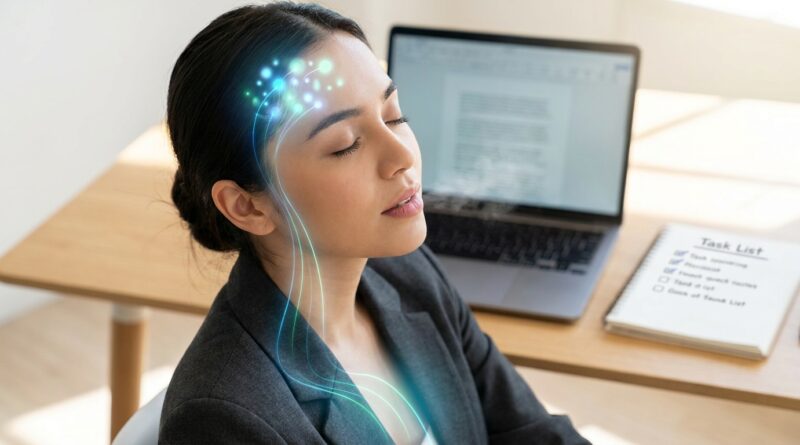
The Breath‑Brain Loop: How Slow Breathing Just Emerged As The Most Underrated Cognitive Enhancer
You know the feeling. You have the focus playlist on, the blue-light glasses nearby, maybe a pricey supplement stack in the drawer, and still your brain goes fuzzy the second stress hits. That is maddening, because it makes you feel like your problem is discipline when it may be basic physiology. A new human study released this week points to a simpler answer. Slow, deliberate breathing appears to change the way signals move between your heart and brain, while also shifting activity in areas tied to attention and decision-making. That is a lot more interesting than “breathing helps you relax.” It suggests that slow breathing cognitive enhancement is not just wellness talk. It may be a real, measurable performance tool. Better yet, it is free, low-risk for most people, and easy to test without turning your life upside down. If your nervous system is stuck in fight or scroll mode, this is one of the few interventions you can try today and actually feel within minutes.
⚡ In a Hurry? Key Takeaways
- Slow, paced breathing may improve focus by changing heart-brain signaling, not just by making you feel calmer.
- Start with 5 to 10 minutes at about 6 breaths per minute, once or twice a day, and track focus before and after.
- It is a low-cost, side-effect-light tool for most people, but anyone with respiratory, cardiac, or panic-related issues should start gently and check with a clinician if unsure.
Why this matters if your focus collapses under stress
Most people chase cognitive performance from the top down. They try to think their way into better focus. More apps. More hacks. More rules.
But stress does not start as a calendar problem. It starts in the body. Faster breathing, tighter muscles, a racing pulse, jumpy attention. Once that loop kicks in, your brain is not in a great state for careful thinking.
That is what makes this new research so useful. It suggests you can nudge cognition from the bottom up. Change the breathing rhythm, and you may change the nervous system state that attention depends on.
What the new study found, in plain English
The headline is simple. Slow, deliberately paced breathing did more than reduce tension. Researchers saw changes in heart-brain communication and shifts in brain activity linked to attention and decision-making.
That matters because your heart and brain are constantly swapping information. When breathing slows in a steady, controlled way, it can strengthen a pattern called respiratory sinus arrhythmia, which is a fancy term for the healthy rise and fall in heart rate that happens with each breath. That pattern is tied to vagal activity, or the “settle down and think clearly” side of your nervous system.
In other words, the benefit may not be mystical at all. It may be mechanical. Breathe more slowly. Improve autonomic balance. Give the brain a better operating environment.
Why this is different from just “taking deep breaths”
“Take a deep breath” is decent advice, but it is too vague to be very useful. People often respond by sucking in a huge breath, lifting the shoulders, and breathing even faster. That can make you feel worse.
Paced slow breathing is different. The goal is not giant breaths. The goal is a calm rhythm. Smooth inhale. Smooth exhale. No strain.
That rhythm seems to be the important part.
The breath-brain loop, without the jargon overload
Think of your brain as trying to work in a noisy room. Stress makes the room louder. Slow breathing turns the volume down.
Here is the rough sequence:
- You slow the breath.
- Your heart rhythm starts to shift in a more organized way.
- Your nervous system gets a stronger “you are safe enough” signal.
- Your attention has a better shot at staying on task.
That does not mean breathing turns you into a genius. It means it may remove one hidden drain on mental performance.
Why high performers should care
If you care about repeatable results, this is appealing for three reasons.
1. It is fast
You do not need to wait six weeks. Many people notice a shift in calm and clarity in a single session.
2. It stacks well
You can use it before deep work, before a meeting, after a stressful email, or as a reset between tasks.
3. It is testable
This is not a vague “be more mindful” instruction. You can set a timer, use a fixed breathing pace, and rate your focus before and after. That makes it much easier to see if it works for you.
A practical protocol you can test this weekend
If you want to try slow breathing cognitive enhancement in a way that is simple and trackable, start here.
The basic protocol
- Sit comfortably. Do not lie down if you tend to get sleepy.
- Breathe through the nose if comfortable.
- Inhale for 4 to 5 seconds.
- Exhale for 5 to 6 seconds.
- Keep the breath light, not huge.
- Continue for 5 to 10 minutes.
That puts you close to 5 to 6 breaths per minute, which is the range often studied in paced breathing work.
When to do it
- Before focused work
- Before a difficult conversation
- After a stress spike
- Mid-afternoon, when attention usually dips
How to track whether it is doing anything
Keep this very boring and simple. That is how you get useful data.
- Rate stress from 1 to 10 before and after.
- Rate focus from 1 to 10 before and after.
- Track whether you can do 25 minutes of uninterrupted work afterward.
- If you have a wearable, note heart rate and HRV trends, but do not obsess over them.
Do this for three days. You will quickly get a sense of whether it helps.
What to expect, and what not to expect
You may notice clearer thinking, less urgency, and better task persistence. You may also notice that you are less likely to bounce to your phone the moment something feels difficult.
What you should not expect is a movie-style transformation. This is more like cleaning a foggy windshield than adding a turbocharger.
That said, clearing the windshield can make a huge difference if stress is what keeps knocking your attention off the road.
Common mistakes that make breathwork feel useless
Breathing too hard
If you are pulling in huge breaths, you may feel dizzy or tense. Ease up.
Going too fast
The whole point is pace. Slow enough that your body gets the message.
Expecting instant enlightenment
You are testing a nervous system tool, not auditioning for a monastery.
Using it only when already overwhelmed
It helps then, yes. But it works even better as a daily baseline habit, before the wheels come off.
Who should be cautious
For most healthy adults, gentle paced breathing is low risk. Still, a few notes matter.
- If you have asthma, COPD, or another breathing condition, start carefully.
- If you have a heart condition, ask your clinician what is appropriate.
- If breath-focused practices trigger anxiety or panic for you, shorten the sessions and keep the breaths natural.
- If you feel lightheaded, stop and return to normal breathing.
This should feel calming or neutral, not like a struggle.
Why this beats chasing one more shiny brain hack
A lot of “focus” products try to push the brain harder. Sometimes that works. Sometimes it just adds jitter on top of an already overloaded system.
Slow breathing goes in the other direction. It lowers the background noise first. That is why it may be especially useful for people who can think well in theory but fall apart under pressure.
And unlike many nootropics, it does not require shipping, subscriptions, or a tolerance-management spreadsheet.
At a Glance: Comparison
| Feature/Aspect | Details | Verdict |
|---|---|---|
| Cost and access | Requires no gear, no prescription, and only 5 to 10 minutes to try. | Excellent entry-level cognitive tool |
| Mechanism | Works through autonomic regulation and heart-brain signaling, which can support attention under stress. | More grounded than many hype-driven hacks |
| Best use case | Ideal before deep work, after stress spikes, or as a daily reset to improve mental steadiness. | Best for stress-sensitive focus problems |
Conclusion
If your attention keeps crumbling the moment stress rises, the fix may not be another capsule or app. It may be the breath pattern feeding your nervous system all day long. This new human study released this week gives that idea more weight. Slow, deliberately paced breathing does not just relax you. It appears to reshape heart-brain signaling and alter activity in regions involved in attention and decision-making. That makes breathwork look a lot less like a fuzzy wellness trend and a lot more like a zero-cost, side-effect-free nootropic lever you can test in a weekend. For people who care about evidence and repeatable cognitive gains, that is the real value. You can turn a lab finding into a simple routine, track it, and keep it if it works. Start small. Five minutes. Calm rhythm. Then see whether your brain feels a little less hijacked and a little more available for the work you actually want to do.