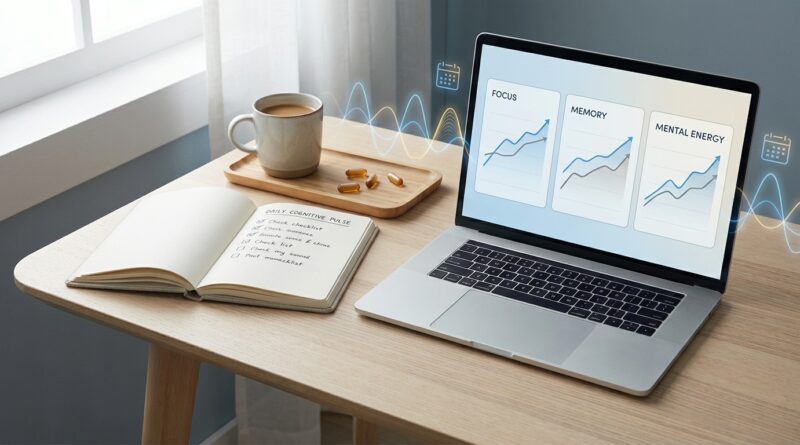
The 10‑Minute Brain Health Check‑In: How A Simple Daily ‘Cognitive Pulse’ Just Became The Smartest Nootropic Habit Of 2026
You are not crazy if your brain feels razor sharp on Tuesday, foggy on Wednesday, and oddly overstimulated on Thursday, even though your supplement stack stayed the same. That is exactly what frustrates so many people chasing better focus. They keep adding magnesium, mushrooms, caffeine, creatine, omega-3s, or fancy nootropics, but they have no simple way to tell what is helping and what is just making them feel more “on.” A daily cognitive health check in for focus and memory fixes that blind spot. It is not a diagnosis. It is a quick 10-minute pulse check you do the same way each day to track attention, short-term memory, mental speed, mood, sleep, and brain fog. Think of it like checking your resting heart rate, except for your mind. With new research showing short digital check-ins can help support cognition, this simple habit may be the smartest upgrade for anyone who wants better data before buying another bottle.
⚡ In a Hurry? Key Takeaways
- A daily cognitive health check in for focus and memory gives you a practical feedback loop, so you can see whether your routine is helping your brain or just making you feel busier.
- Keep it short and repeatable. Spend 10 minutes each morning tracking one attention task, one memory task, plus sleep, stress, mood, and brain fog.
- This is a self-tracking tool, not a medical diagnosis. If you notice a sudden decline, new confusion, or memory problems that interfere with daily life, talk to a clinician.
Why this matters right now
Over the last few days, several clinical trials have pointed in the same direction. Brief, structured digital programs and remote check-ins can help stabilize or improve cognition in older adults and people at higher risk.
That is the part the nootropic crowd often misses. The big lesson is not just that “brain training works” or that “remote care helps.” It is that regular measurement changes the game. If you check in often, patterns appear. If you never check in, everything is a guess.
For most healthy adults trying to sharpen focus, the problem is not a total lack of tools. It is a lack of feedback. You can tweak your diet, sleep, supplements, light exposure, hydration, and exercise all week long, then still not know what moved the needle.
What a “cognitive pulse” actually is
A cognitive pulse is a short, repeatable daily test of how your brain is doing today, not how smart you are in general.
It should be simple enough that you will actually do it. And boring enough that you can compare one day to the next.
The basic idea
Each day, ideally at the same time, you record:
- Attention or reaction speed
- Short-term memory
- Subjective focus
- Brain fog
- Mood and stress
- Sleep quality and duration
That sounds like a lot, but it really is not. Done right, it takes about 10 minutes.
Why supplements alone are such a bad scoreboard
Many nootropics change how you feel before they change how you perform. That is an important difference.
Caffeine may make you feel motivated but also more distractible. Some adaptogens may make you feel calmer but slightly slower. A sleep supplement may improve next-day memory only after several nights. Without tracking, it is easy to mistake stimulation for clarity.
This is why a daily cognitive health check in for focus and memory is so useful. It helps answer the question people almost never ask clearly enough: “Am I actually doing better, or do I just feel different?”
The same logic applies to nutrition. If you are trying something evidence-based, such as vitamin D in people who may be low or at higher risk, tracking helps you see whether any change lines up with your routine. We covered that in The Vitamin D Focus Link: How A Simple Daily Dose Just Boosted Cognitive Scores In High-Risk Adults. The point is not that one nutrient fixes everything. The point is that measuring beats guessing.
How to build your 10-minute daily check-in
Step 1: Pick a fixed time
Morning is best for most people, before work chaos kicks in and before your third coffee changes the picture.
If you want to measure your “natural” baseline, do it before caffeine. If you want to measure your real-world performance, do it after your normal breakfast and first drink. Just be consistent.
Step 2: Use the same mini-tests every day
You do not need a lab. You just need repeatability.
A practical 10-minute setup could look like this:
- 2 minutes: Simple reaction-time or attention app
- 2 minutes: Short memory task, such as recalling a sequence, list, or pattern
- 1 minute: Rate focus from 1 to 10
- 1 minute: Rate brain fog from 1 to 10
- 1 minute: Rate stress and mood
- 1 minute: Record sleep length and quality
- 2 minutes: Note variables like alcohol, hard workout, illness, travel, or a new supplement
You can use a notes app, spreadsheet, habit tracker, or even a paper notebook. The tool matters less than the consistency.
Step 3: Track only a few variables at first
This is where people go off the rails. They start tracking 27 inputs, then quit after three days.
Start with the big ones:
- Sleep
- Caffeine amount
- Exercise
- Stress
- New supplements or dose changes
That is enough to spot useful trends.
What patterns you may start noticing
After one day, you have a data point. After two weeks, you have a story.
You might notice:
- Your attention drops hard after less than 6.5 hours of sleep
- Your “best focus” nootropic helps subjective energy but hurts memory recall
- Late-night alcohol wrecks next-morning processing speed, even when you think you slept fine
- A high-protein breakfast gives steadier scores than a sugary one
- Your brain fog rises before you feel fully burned out
That last one is especially valuable. A cognitive pulse can act like an early warning light. It can show a slide before it turns into a bad week.
What makes this smarter than random brain games
Not all digital brain tools are equal. Some are fun but not very useful for self-monitoring because they change too much day to day or mostly reward practice.
A good check-in tool should be:
- Short
- Repeatable
- Easy to score
- Sensitive to sleep, stress, and fatigue
- Not so hard that it becomes a chore
You are not training for the brain Olympics. You are building a stable personal dashboard.
Common mistakes that ruin the data
Changing too many things at once
If you start a new supplement stack, a new workout plan, intermittent fasting, and blue-light glasses in the same week, you will learn almost nothing.
Testing at random times
A score at 7 a.m. one day and 10 p.m. the next is not a fair comparison.
Obsessing over one bad day
Everyone has off days. Look for trends, not drama.
Using only “how I feel” scores
Subjective ratings matter, but pair them with at least one simple performance task. Feelings alone can mislead you.
Who benefits most from this habit
Pretty much anyone who cares about mental performance, but especially:
- People experimenting with nootropics
- Shift workers
- Adults under chronic stress
- Older adults monitoring day-to-day sharpness
- People recovering from poor sleep, burnout, or illness
- Anyone who says, “Some days my brain just does not work right”
It is low-cost, low-friction, and far more useful than relying on memory alone to judge your memory.
When to get medical help instead of just tracking
A daily pulse is a self-awareness tool. It is not meant to replace proper care.
Talk to a healthcare professional if you notice:
- A sudden drop in memory or attention
- New confusion
- Trouble managing bills, appointments, or daily tasks
- Frequent word-finding problems that are getting worse
- Changes after a head injury
- Concerns from family or coworkers about your cognition
If the pattern looks serious, do not wait for another week of spreadsheet entries.
How to use your results without becoming obsessive
The goal is not to micromanage every mental blip. The goal is to make better decisions with less guesswork.
Once you have 2 to 4 weeks of data, ask:
- What habits show up on my best days?
- What habits show up on my worst days?
- Which supplement changes produced no meaningful improvement?
- What seems to protect me from brain fog?
That is where the money-saving part kicks in. You may find that your expensive “focus” stack did less than simply fixing sleep timing, cutting late caffeine, or correcting a nutritional gap.
At a Glance: Comparison
| Feature/Aspect | Details | Verdict |
|---|---|---|
| Daily cognitive pulse | 10 minutes, same tests each day, tracks focus, memory, sleep, and brain fog | Best for spotting trends and testing whether habits or nootropics actually help |
| Relying on “how I feel” | Fast and easy, but highly biased by stress, caffeine, mood, and expectations | Useful as one part of tracking, but weak on its own |
| Buying new supplements without tracking | Common habit, expensive over time, gives little real feedback | Worst option if your goal is real improvement rather than hype |
Conclusion
The smartest brain-health habit of 2026 may not be a new powder, pill, or app subscription. It may just be paying attention in a structured way. In the last few days, several clinical trials have highlighted how brief, structured digital programs and remote check-ins can stabilize or improve cognition in older adults and high-risk groups, yet the average biohacker still flies blind with no feedback loop for their own brain. A simple, repeatable daily cognitive pulse gives our community an immediate way to turn those research insights into practice. It helps people stop wasting money on interventions that do nothing for them, spot early warning signs of brain fog before they spiral, and fine-tune lifestyle and nootropic choices based on real, personal data rather than hype. Ten minutes a day is not much. But it is enough to stop guessing and start seeing what your brain is actually telling you.