The Copper Clean‑Up: How A Little‑Known Compound Just Cleared Alzheimer’s Toxins And Boosted Memory In The Lab
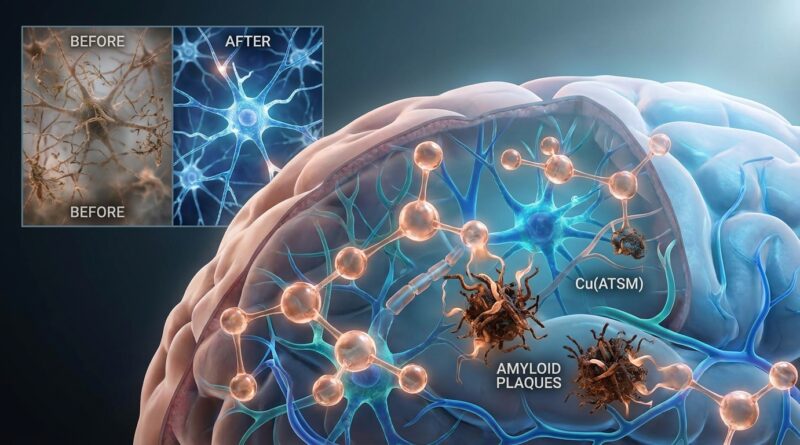
If you have ever tried to sort real brain science from glossy supplement marketing, you know how tiring it gets. One bottle promises sharper focus. Another promises “brain detox.” Most of it falls apart the second you ask a simple question. Has this actually helped with a real disease like Alzheimer’s? That is why this new Cu(ATSM copper compound Alzheimer’s cognitive enhancement study is worth a serious look. In lab models, researchers found that Cu(ATSM), a small copper-carrying compound, cut toxic Alzheimer’s protein buildup by about 40 percent, helped repair the brain’s waste-clearing system, and improved learning performance. That does not mean we suddenly have a cure. It does mean this is more interesting than the usual nootropic chatter, because it targets known disease machinery and it has already gone through basic human safety testing in other neurological conditions. For families watching memory changes up close, that makes this one hard to ignore.
⚡ In a Hurry? Key Takeaways
- Cu(ATSM) looks promising because it reduced toxic Alzheimer’s proteins, repaired waste-removal pathways, and improved memory-like performance in animal studies.
- If you are judging brain-health news, look for treatments that affect disease mechanisms, not just “energy” or “focus” claims.
- This is still early-stage research. Encouraging, yes. Ready for self-experimenting or supplement shopping, no.
What exactly is Cu(ATSM)?
Cu(ATSM) is a compound designed to carry copper into cells, including cells in the brain. Copper sounds ordinary, almost too ordinary, but in biology it matters a lot. Nerve cells use it in energy production, antioxidant defense, and other basic maintenance jobs.
The catch is that copper has to be in the right place, in the right amount, at the right time. Too little can hurt cell function. Too much in the wrong setting can add stress. So this is not about chugging copper supplements from the vitamin aisle. It is about a very specific molecule that can cross into the brain and deliver copper in a controlled way.
Why researchers think it matters for Alzheimer’s
Alzheimer’s is not just one problem. It is a pileup of problems. Toxic proteins build up. Brain cells struggle to make energy. Cleanup systems slow down. The blood-brain barrier, which is supposed to act like a smart filter and protective wall, starts to lose its edge.
That last part often gets less attention than plaques and tangles, but it is important. Your brain has systems for clearing waste. When those systems weaken, harmful proteins can stick around longer than they should.
What makes Cu(ATSM) stand out is that it seems to affect several of these weak spots at once, not by acting like a stimulant, but by helping damaged brain systems work more normally again.
What the new lab study found
Here is the short version. In animal models of Alzheimer’s disease, Cu(ATSM) treatment was linked to three headline results.
1. It reduced toxic protein buildup
The study reported roughly a 40 percent drop in toxic Alzheimer’s-related proteins. That is the result grabbing attention, and for good reason. Lowering the burden of these proteins is one of the main goals in Alzheimer’s research.
2. It repaired the brain’s waste-removal “pumps”
This may be the most interesting piece. Think of the brain’s cleanup system like a home sump pump or a city drainage system. If the pumps fail, the junk backs up. According to the study, Cu(ATSM) helped restore these waste-clearing mechanisms, which may be part of why protein levels fell.
3. It improved learning performance
This is the result everyday readers care about most. The treated animals performed better on learning and memory-related tasks. That does not guarantee the same effect in humans, but it is much more useful than a paper that only shows a chemical change with no sign of behavioral improvement.
Why this is more believable than a typical “brain booster” claim
A lot of products marketed for cognition work by making you feel something. More alert. More stimulated. Less foggy for a few hours. That is not the same as slowing or changing a disease process.
Cu(ATSM) is getting attention because it appears to work upstream, on mechanisms that scientists already worry about in Alzheimer’s. Protein clearance. Barrier repair. Mitochondrial support. Cellular stress. Those are serious targets.
That does not make success guaranteed. Alzheimer’s research is full of treatments that looked great in mice and then disappointed in people. Still, this is the kind of result you want to see before getting excited. There is a plausible reason it might work, and the lab data points in the same direction.
The part that makes this especially interesting: it is not starting from zero
One reason this story has legs is that Cu(ATSM) has already been through basic human safety testing in other brain-related diseases. That matters a lot.
Drug development usually stalls because even a smart idea can fail on safety, dosing, or delivery. A compound that already has some human clinical background has a shorter, more realistic path than a molecule that only exists in petri dishes and mouse brains.
To be clear, “basic safety testing” does not mean proven safe for everyone, for every dose, or for Alzheimer’s specifically. It just means this is not a total unknown. In drug development terms, that is a meaningful advantage.
What this does not mean
This is where it helps to stay grounded.
It does not mean copper supplements prevent Alzheimer’s
Please do not turn this into “copper is good for memory, therefore more copper is better.” Biology does not work like that. Cu(ATSM) is a specific delivery system. Free-form copper supplements are not interchangeable with it, and too much copper can be harmful.
It does not mean a cure is around the corner
Animal studies are useful, but they are not the finish line. Many therapies have looked strong in mice and then failed in human trials because human Alzheimer’s is more complex, slower-moving, and tangled up with age, blood vessels, inflammation, sleep, and genetics.
It does not mean you should buy the first “copper nootropic” you see online
That is exactly how hype cycles trick people. A serious research compound gets headlines, and then weaker products borrow the language without the science.
So why are nootropics people paying attention?
Because this study nudges the conversation away from the usual stimulant-in-disguise products and toward something more mature. If this line of research holds up, it could change what people mean when they talk about cognitive enhancement.
Instead of asking, “Will this make me feel sharper by lunch?” the better question becomes, “Does this support the systems that keep the brain healthy over time?” That includes energy production in mitochondria, clearance of toxic proteins, and the integrity of the blood-brain barrier.
That is a much better standard. It is also harder to fake.
What to watch for next
If you want to follow this story without getting swept up in headlines, keep an eye on a few practical markers.
Human trials in Alzheimer’s
This is the big one. The next important step is testing whether the same cleanup and cognitive effects show up in people, not just in animal models.
Biomarker data
Researchers will likely look at whether Cu(ATSM) changes measurable signs of disease, such as protein levels, imaging results, or markers of barrier function and inflammation.
Dosing and timing
Many brain therapies work better if used early, before damage becomes extensive. One key question is whether this kind of compound helps most in prevention, early disease, or later stages.
Side effect profile
Even a promising compound has to be tolerated well enough for real-world use, especially in older adults who often take multiple medications.
What you can do right now
If Alzheimer’s prevention or cognitive decline is on your mind, the best move today is not to chase copper products. It is to get better at spotting what counts as meaningful evidence.
Here is a simple filter you can use:
- Does the treatment target a known disease mechanism?
- Has it shown benefits beyond cell cultures, such as behavior or cognition in animals?
- Is there any human safety or clinical data at all?
- Are the claims specific, or are they vague marketing words like “clarity” and “detox”?
Cu(ATSM) passes more of those tests than most products in the brain-health world. That is why it deserves attention, even if caution still comes with it.
At a Glance: Comparison
| Feature/Aspect | Details | Verdict |
|---|---|---|
| Evidence strength | Animal-model results showed lower toxic proteins, repaired clearance systems, and better learning performance. | Promising, but still pre-human for Alzheimer’s effectiveness. |
| Mechanism | Targets copper delivery, mitochondrial support, blood-brain barrier function, and protein waste clearance. | More compelling than generic “brain boost” products. |
| Real-world readiness | Compound has passed basic human safety testing in other neurological conditions, but not yet proven as an Alzheimer’s treatment. | A realistic candidate to watch, not something to self-prescribe. |
Conclusion
This is why the Cu(ATSM copper compound Alzheimer’s cognitive enhancement story matters right now. It is not just another shiny brain pill claim. A new study found that Cu(ATSM) cleared roughly 40 percent of toxic Alzheimer’s proteins, repaired the brain’s waste-removal pumps, and improved learning in animal models. On top of that, the compound has already cleared basic human safety hurdles in other brain diseases, which gives it a more realistic path forward than many early lab ideas. That puts it in a rare bucket. It is scientifically interesting, practical enough to take seriously, and relevant to where cognitive medicine may be heading next. The smart takeaway is not to rush out and buy copper supplements. It is to use this as a model for what a real breakthrough starts to look like. As the hype machine spins up, that kind of evidence-first mindset will help you spot the genuine advances and ignore the pretenders.