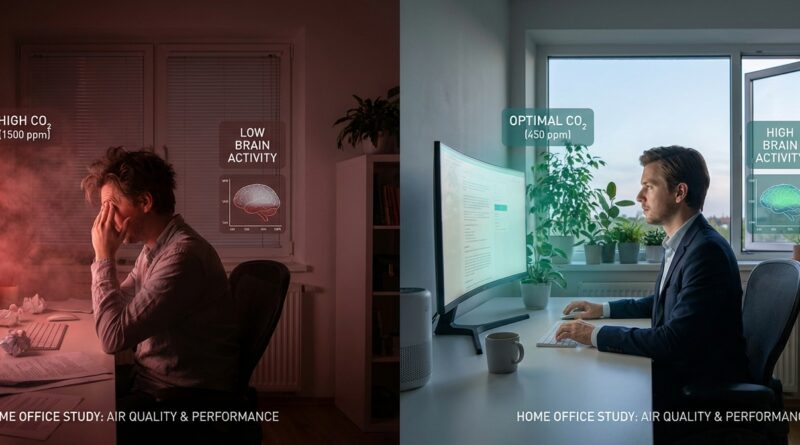
The CO₂ Brain Trap: The Overlooked “Indoor Toxin” Quietly Killing Your Focus
You are not lazy, broken, or suddenly bad at concentrating. It is maddening to spend money on nootropics, clean up your diet, and still hit that familiar wall at 2 or 3 p.m. where your thoughts slow down, your eyes feel heavy, and even simple tasks start to feel weirdly hard. A lot of people blame stress, poor sleep, or the wrong supplement stack. Sometimes those are part of the picture. But sometimes the real problem is much less obvious. It is the room itself. High indoor CO₂ can creep up in bedrooms, home offices, meeting rooms, and small workspaces, especially when windows stay shut and ventilation is weak. You still have oxygen in the air, but rising CO₂ often goes hand in hand with stale indoor conditions that can leave you feeling foggy, sleepy, and mentally flat. Before you buy one more capsule, it is worth checking the air around your brain.
⚡ In a Hurry? Key Takeaways
- CO2 levels and brain fog are often linked in poorly ventilated rooms, especially in small offices and bedrooms.
- Start with basics first. Measure indoor CO₂, improve ventilation, and keep temperature and humidity in a comfortable range.
- If you have severe fatigue, headaches, breathing trouble, or ongoing concentration issues, do not assume it is just air quality. Get medical advice too.
Why this gets missed so often
Most people think of indoor air problems as dramatic stuff. Smoke. Mold. A gas leak. Something you can smell or see.
CO₂ is different. It builds quietly. You can be sitting in a tidy room with a nice desk setup, expensive monitor, filtered coffee, and a carefully planned supplement routine, while the air slowly turns stale enough to drag your focus down.
That is why this trap is so easy to miss. The symptoms are vague. Brain fog. Sleepiness. Mild headache. A sense that your brain is running on low battery. You may assume you need more caffeine, a better stack, or stronger discipline.
Sometimes you just need fresh air.
What CO₂ actually does indoors
Let us keep this simple. Carbon dioxide is a normal part of air, and you breathe it out all day. Outdoors, it usually disperses. Indoors, especially in sealed spaces, it can collect fast.
When CO₂ levels rise indoors, it is often a sign that ventilation is not keeping up with the number of people in the room. That matters because stale air can make you feel sluggish and less sharp, even if the room looks perfectly fine.
This is why the phrase CO2 levels and brain fog keeps coming up. People notice the pattern before they know the reason. They think better after opening a window, stepping outside, or moving to a larger room. Then the fog returns when they go back to the same space.
Common signs your room may be the problem
You do solid work in the morning, then fade fast by afternoon.
You feel oddly sleepy during video calls or long desk sessions.
You wake up groggy even after a decent number of hours in bed.
You feel better outdoors within 10 to 20 minutes.
You rely more and more on caffeine as the day goes on.
The home office and bedroom are repeat offenders
People often imagine poor air quality as an office tower problem. But home setups can be worse. A small room, closed door, closed window, one person breathing for hours, maybe a computer warming the room, and not much airflow. That is a very normal recipe for stale air.
Bedrooms are another big one. If you sleep in a small room with the door and windows shut, CO₂ can rise overnight. You may not notice anything dramatic, but you wake up feeling like your brain never quite started properly.
Then you spend the morning trying to fix that feeling with coffee, supplements, or pure stubbornness.
It is not just CO₂. Temperature and humidity matter too
This is where a lot of people overcomplicate things. They chase one magic fix. Real life is messier than that.
Your brain likes a decent indoor environment. If CO₂ is high, the room is too warm, and the air is too dry or too damp, your focus can fall apart faster. You feel sticky, tired, distracted, and less patient. Your stack may still help a bit, but it is fighting uphill.
A brain-friendly target zone
As a practical starting point, aim for:
- CO₂: ideally lower rather than higher, with many people trying to keep workspaces under about 800 to 1,000 ppm when possible
- Temperature: often around 68 to 75°F, depending on your comfort
- Humidity: roughly 40 to 60 percent
These are not magic numbers. They are sensible targets. The main point is that your brain works better when the room is not stale, stuffy, hot, or swampy.
How to tell if CO₂ is behind your brain fog
You do not need to turn your house into a science lab. Start with observation.
Run the simple before-and-after test
Next time your focus tanks, step outside for 10 to 15 minutes. No phone if possible. Just walk or sit in fresh air. Then come back and notice whether your head feels clearer.
Also try working for one day with a window cracked open, if weather and safety allow. If your afternoon slump noticeably improves, that is a clue.
Use a CO₂ monitor
If you want real proof, buy a decent indoor air quality monitor that measures CO₂. Not every cheap gadget is accurate, so read reviews carefully. You do not need a fancy commercial unit, but you do want one that gives stable readings you can trust.
Check your bedroom overnight. Check your home office after two hours with the door shut. Check a small conference room after a long meeting. The numbers can be eye-opening.
What to do before you buy another supplement
This is the practical part. If your room is the problem, the fix is often boring. That is good news. Boring fixes are usually cheaper.
1. Increase fresh air
Open a window. Open the door. Create cross-ventilation if you can. Even a little air exchange can help.
2. Change rooms
If one room keeps making you sleepy, test another one. Larger spaces often stay fresher longer.
3. Take air breaks
Every 60 to 90 minutes, stand up and step outside for a few minutes. It sounds almost too simple. It still works.
4. Watch room occupancy
CO₂ rises faster when more people are in a small space. That meeting room that makes everyone dumb by minute 40 is not your imagination.
5. Fix heat and humidity
If the room is too warm, cool it down. If humidity is way off, use a humidifier or dehumidifier as needed. Comfort and cognition are closely linked.
6. Use your stack after the basics
Supplements may still have a place. But they should support a good environment, not compensate for a bad one.
What air purifiers can and cannot do
This part trips people up. A standard HEPA air purifier can be great for dust, pollen, and particles. It does not usually remove CO₂.
So if your room feels stuffy because exhaled air is building up, an air purifier alone may not solve it. You need ventilation. Fresh air in, stale air out.
That does not make purifiers useless. If allergies or particulates are also affecting how you feel, they can still help. Just do not expect them to fix CO₂ by themselves.
When brain fog is not just an air issue
Indoor air matters. A lot. But it is not the answer to everything.
If your focus problems are severe, constant, or paired with symptoms like chest tightness, fainting, heavy snoring, low mood, major sleep issues, or frequent headaches, talk to a healthcare professional. Brain fog can also be tied to sleep apnea, anemia, medication side effects, thyroid issues, blood sugar swings, and plenty of other things.
The smart move is not to pick one theory and cling to it. It is to remove obvious bottlenecks one by one.
A simple checklist for the next 7 days
If you want a practical reset, do this for one week:
- Check whether your worst brain fog happens in the same room at the same time
- Open windows or doors for air exchange during work blocks
- Take one short outdoor break every 60 to 90 minutes
- Keep your workspace comfortably cool, not stuffy
- Keep humidity in a moderate range if possible
- Use a CO₂ monitor in your office and bedroom if you can
- Only judge your supplements after you have improved the room
That last point matters. If your environment is quietly dragging your brain down, you may be rating your stack unfairly.
Why this matters for people who love optimization
There is nothing wrong with wanting better focus. Most of us do. But the danger with optimization culture is that it can make us look for answers only in products. Better pill. Better powder. Better protocol.
Sometimes the missing piece is much more basic. Air. Light. Temperature. Sleep environment. The stuff that feels too obvious to matter.
It matters anyway.
At a Glance: Comparison
| Feature/Aspect | Details | Verdict |
|---|---|---|
| High indoor CO₂ | Common in closed bedrooms, home offices, and crowded meeting rooms. Often linked with sleepiness, headaches, and stale-air brain fog. | Worth checking first because it is easy to miss and often easy to improve. |
| Supplements for focus | May help some people, but they cannot fully make up for a stuffy, overheated, poorly ventilated room. | Use them as support, not as a replacement for good air and sleep basics. |
| Ventilation, temperature, and humidity | Fresh air, a comfortable temperature, and moderate humidity improve comfort and make sustained focus easier. | Best first-line fix because it helps every routine, every stack, and every workday. |
Conclusion
If your focus keeps falling apart and nothing in your supplement drawer seems to fix it, do not ignore the room you are sitting in. Looking at CO2 levels and brain fog is not glamorous, but it is one of the smartest reality checks you can do. This helps the Cognesium community today because it shifts the conversation from endlessly debating ingredient lists to fixing a silent bottleneck that affects literally every stack: brain oxygenation and air quality. Start with a simple checklist. Check CO₂ if you can. Cool the room down. Fix humidity. Get more fresh air into your workspace and bedroom. Then see how your brain responds. That is how you solve real-world focus problems, not just collect more bottles.